
Is Testosterone Gel Right for You? A Plain-English Guide for Men
- Published:
- Last medically reviewed:
Feeling constantly tired, losing your drive, or noticing your mood, body, and libido aren’t what they used to be? For many men, low testosterone is the underlying cause — and testosterone gel is one of the most effective, convenient, and widely used treatments available in the UK today.
Applied once daily to the skin and absorbed into the bloodstream, testosterone gel restores your levels steadily and naturally — with no needles, no clinic appointments for injections, and no dramatic peaks and troughs in how you feel. This guide explains everything you need to know: what gel is available, how to use it correctly, what to watch for, and how to get started with expert testosterone replacement therapy (TRT) at The Health Suite in Leicester.
What Does Low Testosterone Actually Feel Like?
Low testosterone — medically known as male hypogonadism — is more common than most men realise, and far more treatable than most men know. It’s not just about sex drive. The symptoms can affect almost every area of your life:
- Persistent, unexplained fatigue — tired even after a full night’s sleep
- Low mood, irritability, or a flat feeling that won’t shift
- Reduced sex drive or difficulty with erections
- Loss of muscle mass and strength despite exercise
- Increased body fat, especially around the abdomen
- Poor concentration, memory lapses, or brain fog
- Loss of bone density, joint aches, or reduced physical stamina
- Hot flushes or sweating in men
If several of these sound familiar, low testosterone may well be a contributing factor. A straightforward blood test is the starting point for a formal assessment.
What is Testosterone Gel and How Does it Work?
Testosterone gel is a prescription-only treatment that delivers testosterone directly through the skin. You apply a small amount each morning to your shoulder, arm, or thigh — and within minutes, the gel absorbs into the bloodstream. Your testosterone levels rise gently and stay stable throughout the day, reflecting the natural pattern of testosterone in a healthy man.
This stability is one of gel’s principal advantages. Unlike testosterone injections, which produce a noticeable peak after administration and a gradual decline before the next dose, gel maintains more consistent levels day to day — reducing the symptom variation some men experience with less frequent injection schedules.
Testosterone gel is approved by the MHRA for adult men with clinically confirmed low testosterone, and it is one of the most prescribed forms of TRT in the UK — available both on the NHS and through private clinics such as The Health Suite.
Which Testosterone Gel Products Are Available in the UK?
Three testosterone gel products are currently licensed by the MHRA for men with hypogonadism in the UK. Each works in the same fundamental way but differs in how it is applied and how the dose is adjusted. Your doctor will recommend the most suitable option based on your needs, lifestyle, and dose requirements.
| Product | Strength | Where to Apply | Key Features |
| Testogel 16.2 mg/g | 1.62% | Shoulders and upper arms only | The most widely prescribed testosterone gel in the UK. Comes as a convenient pump (88 g, multi-dose) or individual sachets. Dose is adjusted in pump-actuation steps. Prime the pump with 3 presses before the very first use. |
| Testogel 50 mg sachets | 1.0% | Shoulders, upper arms, or abdomen | The only UK-licensed gel also approved for abdominal application — useful if the shoulder area causes irritation. Supplied as 5 g single-use sachets. |
| Tostran 2% gel | 2.0% | Abdomen and/or inner thighs | The only UK gel licensed for inner thigh application. Each pump actuation delivers 10 mg of testosterone — the finest dose adjustment available, making it easy to fine-tune your levels. Comes as a 60 g metered-dose pump. |
| Testavan 20 mg/g | 2.0% | Upper arm and shoulder (via built-in applicator) | Unique design: a built-in applicator transfers the gel from pump to skin without your hands touching the gel — significantly reducing the risk of accidental transfer to a partner or child. 85.5 g pump. |
How to Apply Testogel
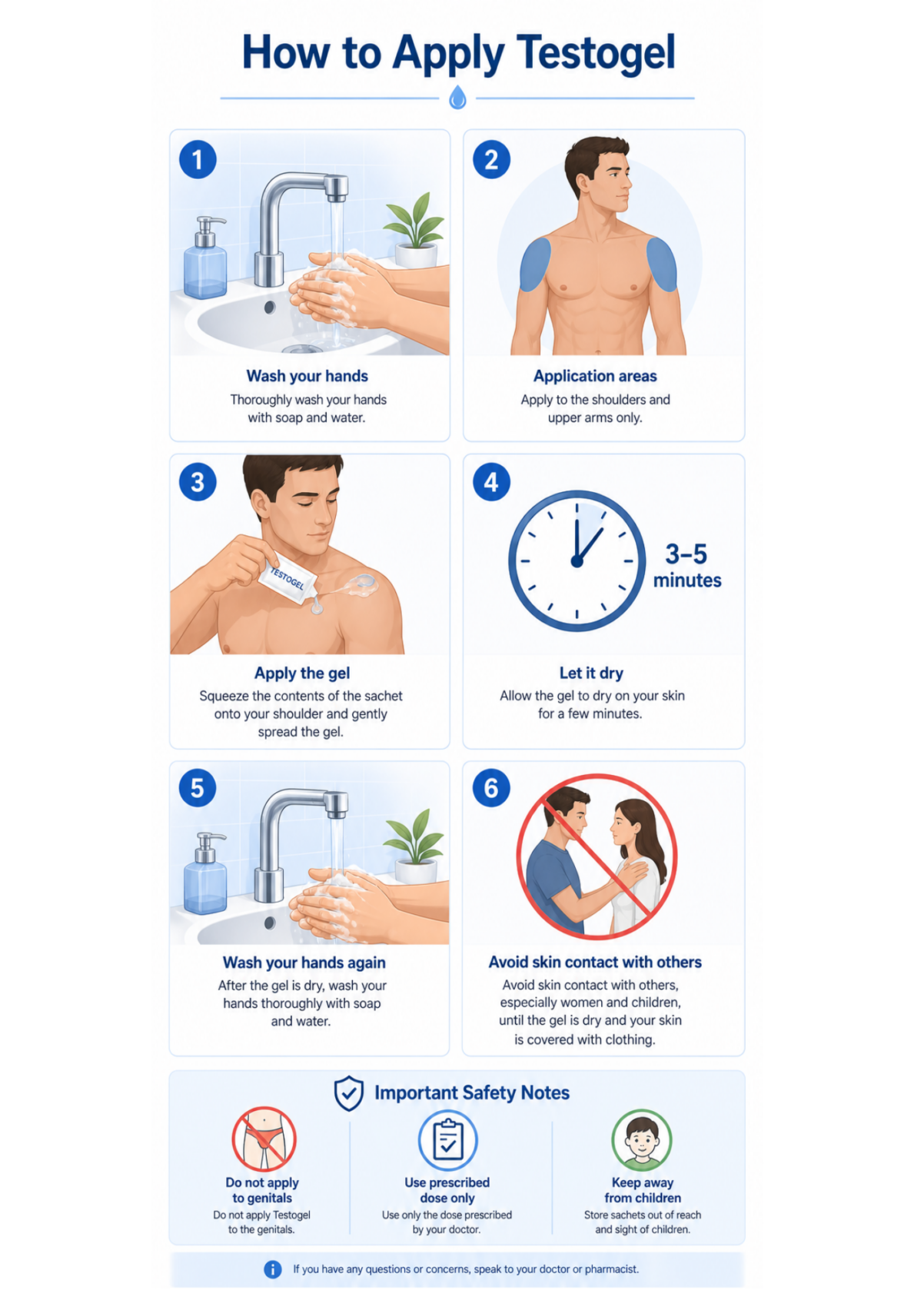
How to Apply Testosterone Gel Correctly
Getting the application right matters — it’s what ensures you absorb a consistent dose each day and protects the people around you from accidental exposure. The steps below are a general guide; always follow your prescribing doctor’s specific instructions and the Patient Information Leaflet for your particular product.
Before You Apply — Every Day
- Apply at the same time each morning, ideally straight after your shower. Morning application fits the body’s natural testosterone rhythm, which peaks in the early hours and tapers through the day.
- The skin needs to be clean, dry, and free from moisturiser, sunscreen, or deodorant before you apply. These can interfere with absorption.
- Wash your hands before handling the pump or sachet.
Testogel — Applying to Shoulders and Upper Arms
- Prepare your dose: for the pump, press down the required number of times to dispense the gel into your palm. For sachets, tear open at the line and squeeze the entire contents onto your hand or directly onto the skin.
- Spread a thin, even layer over both shoulders and/or upper arms — roughly the area a short-sleeved T-shirt would cover. No vigorous rubbing required; gentle spreading is enough.
- Let the gel dry for around 3 to 5 minutes before getting dressed.
- Wash your hands thoroughly with soap and water straight away.
- Don’t shower, swim, or bathe for at least 1 hour after applying. If you can wait 6 hours before washing the area, absorption will be more complete — but this isn’t always practical and one hour is the minimum.
Tostran — Applying to Abdomen or Inner Thighs
- Tostran goes on the abdomen or inner thighs — not the shoulders or arms.
- For the abdomen: spread evenly across an area of at least 10 cm x 30 cm (roughly the size of an A4 page laid sideways), using one finger.
- For the inner thighs: split the dose equally between both thighs, covering at least 10 cm x 15 cm on each side.
- Alternate between abdomen and thighs from day to day to give the skin a chance to recover and reduce irritation.
- Let it dry fully before dressing, and don’t shower for at least 2 hours.
- Wash your hands straight after.
Testavan — Using the Built-in Applicator
- Testavan’s built-in applicator is its defining feature — the gel transfers from the pump to your skin via the applicator, not your hands.
- This removes the main window of accidental transfer during the application process itself.
- Apply to the upper arm and shoulder only, following the device instructions in the Patient Information Leaflet.
- Let it dry before dressing. Don’t shower for at least 2 hours.
- Wash your hands after removing the applicator.
What If You Miss a Dose?
Apply it as soon as you remember — as long as it is still the same day. If it’s already the next morning, skip the missed dose entirely and carry on as normal. Never apply two doses to make up for a missed one. If you’re unsure, just give us a call.
Protecting Your Partner and Children from Accidental Exposure
Testosterone gel can transfer from your skin to another person through direct contact — and even small amounts can affect women and children. This isn’t a reason to avoid treatment; it’s something easily managed with a few straightforward habits. The MHRA issued updated guidance on this in January 2023, and it’s one of the things we always cover at your initial consultation.
The Key Precautions
- Wash your hands with soap and water immediately every time you apply.
- Cover the application site with clothing (a T-shirt) once the gel has dried.
- For any close physical or intimate contact, either wait at least 6 hours from when you applied, wash the application site thoroughly with soap and water first, or make sure the area stays covered.
- The minimum ‘safe contact’ window if you can’t wash first: 1 hour for Testogel; 2 hours for Tostran and Testavan.
- Pregnant women and young children should not come into contact with the application area, or with towels and clothing that have touched it before washing.
What to Watch For in Others
If a partner or child may have come into contact with the gel, wash the skin immediately with soap and water. Signs that warrant a prompt medical check include:
- In women: unexpected facial or body hair, changes in voice, acne, or disrupted periods.
- In children: early pubic or underarm hair, genital enlargement, acne, or unusually rapid growth.
Side Effects — What to Expect and What to Watch For
Testosterone gel has a well-established safety record when prescribed and monitored appropriately. Most men tolerate it well, and side effects — where they occur — are generally mild and manageable. The following covers what to expect.
Common and Usually Mild
- Skin reactions at the application site — redness, mild itching, or dryness. Rotating where you apply can help.
- Acne or oilier skin, particularly in the early months of treatment.
- A natural rise in red blood cell count — this is expected and monitored via blood tests.
- Minor fluid retention, breast tenderness, or mood shifts, usually as your body adjusts.
- Changes in libido — these often settle once your levels stabilise in the therapeutic range.
Less Common but Important to Know About
- Polycythaemia — if the red blood cell count rises too high, blood becomes more viscous, increasing clot risk. Symptoms include persistent headaches, dizziness, and a flushed or ruddy complexion. This is why regular blood tests are a core part of TRT care. Contact The Health Suite promptly if these symptoms develop.
- Worsening sleep apnoea — testosterone can affect upper airway muscle tone. Inform your prescribing doctor if you develop new or worsening snoring, episodes of waking with breathlessness, or significant daytime sleepiness.
- Elevated PSA — testosterone at physiological levels raises PSA modestly. This is monitored routinely and does not mean prostate cancer. The TRAVERSE trial (Lincoff et al., NEJM, 2023) — the largest RCT of TRT to date, with 5,204 men — found no significant increase in prostate cancer in men treated with testosterone gel versus placebo over 33 months.
Contact Us or Seek Emergency Care If...
- You develop sudden leg pain, swelling or redness (possible deep vein thrombosis), or sudden breathlessness and chest pain (possible pulmonary embolism) — call 999.
- You have a persistent erection lasting more than 4 hours (priapism) — attend A&E immediately.
- You notice severe acne, significant mood changes, or signs of blood being too thick (headaches, visual changes, ruddy skin) — contact The Health Suite.
Who Should Not Use Testosterone Gel
Testosterone gel is not suitable for men with known or suspected prostate cancer, breast cancer, or a documented allergy to testosterone or any of the gel’s ingredients. Your doctor will screen for these at your initial consultation before any prescription is issued.
What Does Monitoring Look Like on Testosterone Gel?
Starting testosterone gel is straightforward, but it requires ongoing clinical oversight. Regular blood tests and review appointments are a standard part of treatment — not a cause for concern. They exist to confirm that your levels are in the optimal range and that you are responding well.
Before You Start
Before your first prescription, baseline blood tests establish a clear clinical starting point. These check your testosterone levels (on two separate mornings), red blood cell count, PSA if you are over 40, liver function, cholesterol, and blood sugar. Blood pressure and a full symptom review are conducted at the same appointment. Treatment is only initiated once the full clinical picture is in place.
The First Three to Six Months — Getting Your Dose Right
A follow-up blood test at around three months confirms whether your testosterone has reached the target range and that your red blood cell count is within safe limits. Your prescribing doctor will also review your symptoms — energy, mood, libido, and any side effects experienced. If a dose adjustment is needed, it is made at this point and a further blood test is arranged four to six weeks later to confirm the new level.
Once Your Dose is Stable
After the first year, most patients move to annual reviews — a blood test combined with a clinical assessment. If anything changes between scheduled reviews, contact The Health Suite to arrange an earlier appointment rather than waiting.
What We're Primarily Checking
The two most important numbers are your testosterone level (confirming it stays in the healthy mid-normal range) and your haematocrit (a measure of red blood cell concentration). Catching any upward drift in haematocrit early keeps the risk of blood clots firmly in check — which is exactly why routine monitoring exists. PSA is checked annually in men over 40 as standard prostate health surveillance.
Your Questions Answered
These are the questions men most frequently ask about testosterone gel. For anything not covered here, please contact The Health Suite or book a consultation.
Ready to Take the Next Step?
If you recognise the symptoms of low testosterone — or you already have blood results indicating low levels and want expert guidance on treatment options — The Health Suite offers comprehensive TRT consultations in Leicester, covering diagnosis, product selection, prescription, and full ongoing monitoring.
Assessment begins with a clinical consultation and baseline blood tests. No further commitment is required beyond that initial step.

Testosterone Replacement Therapy
Private TRT consultation at The Health Suite. Get doctor-led Testosterone Replacement Therapy backed by detailed clinical blood monitoring.