
Puberty is a natural stage of development during which a child’s body begins to mature into adulthood [1][2]. In the UK, most girls begin puberty between the ages of 8 and 13, while boys typically start between 9 and 14 [2]. But when physical changes begin significantly earlier than these ranges, this is known as precocious puberty, or early puberty [2]. UK clinical guidance defines early puberty as the development of secondary sexual characteristics before age 8 in girls and before age 9 in boys [2].
According to NHS data, early puberty is considerably more common in girls than in boys and often has no identifiable underlying cause in girls.2 In boys, however, early puberty is more likely to be associated with an underlying medical factor [2]. Registry studies have also reported substantial increases in central precocious puberty incidence from 1998-2017, attributed partly to earlier recognition alongside true shifts in pubertal timing [3]. Understanding early puberty signs in a child helps parents recognise when development may be ahead of the expected range and when medical advice would be appropriate.
What Happens During Puberty
Puberty is a critical transitional period which starts when special nerve cells in the brain begin releasing a hormone called GnRH in short bursts, which ‘switches on’ the body’s puberty system [4][5].
This signal tells the pituitary gland (a small gland at the base of the brain) to release two more hormones, LH and FSH, into the bloodstream. These travel to the reproductive organs and tell them to start making higher levels of sex hormones. In turn, these hormones drive the growth spurt, changes in body shape, and the gradual development of the body’s reproductive system [4][5].
As puberty progresses, the body uses feedback loops to keep hormone levels in balance so things don’t move too quickly or too slowly. Rising sex hormone levels send signals back to the brain to gently adjust how much GnRH, LH, and FSH are released [4][5].
Other hormones, such as growth hormone and IGF-1, boost height and muscle development, while hormones from the adrenal glands contribute to changes like body odour and hair growth [4][5]. All of these systems work together over several years to support a steady, coordinated transition from childhood into adulthood.
Early Signs of Puberty in Girls
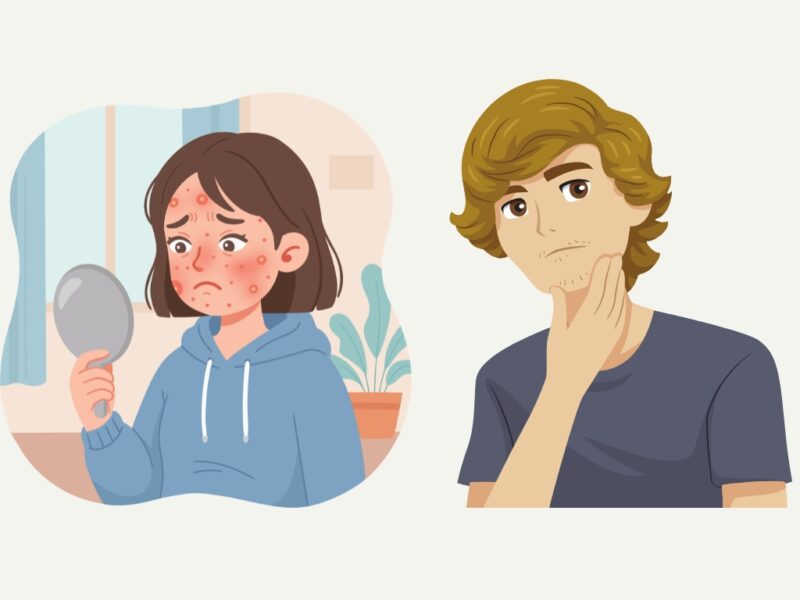
In girls, the earliest and most common sign of puberty is breast development. If breast budding appears before age 8 and progresses over time, this may indicate early puberty [6]. Other early puberty signs in girls include the development of pubic or underarm hair, noticeable growth acceleration compared with peers, acne, body odour changes and, in some cases, the onset of menstruation before age 10. While isolated early breast tissue can occasionally occur without full pubertal activation, progressive development over several months warrants assessment [7][8].
In the UK, the average age of first menstruation (menarche) is now approximately 12 to 13 years, according to national cohort data such as Wellcome Open Research [9][10][11]. Alongside physical changes, some girls also notice shifts in sleep, appetite and mood as puberty gets underway. They may feel hungrier than usual, tire more easily or have difficulty falling asleep, especially around times of rapid growth. Mood swings, feeling more irritable or tearful, and becoming more self‑conscious about body changes are also common [12].
On their own, these changes are usually a normal part of puberty, but when they appear earlier than expected or start to affect school, friendships or daily life, it can be helpful to seek advice. Additional UK birth cohort insights have shown that earlier pubertal timing in girls is associated with higher rates of emotional difficulties in adolescence, highlighting why monitoring well-being is important when development begins early [13][14].
Early Signs of Puberty in Boys
Early puberty is less common in boys but more likely to have an identifiable cause. The earliest and most reliable sign is testicular enlargement before age 9 (defined as testicular volume reaching at least 4 mL, Tanner stage 2) [15]. Because early testicular enlargement can be subtle, boys may present later in the process, making awareness particularly important. Other features may include an increase in penile size, the appearance of pubic or underarm hair, rapid height growth, voice deepening, acne and increased muscle mass [8].
Alongside these physical signs, some boys may show changes in mood, energy and behaviour as puberty starts earlier than expected. They might become more irritable or impulsive, seek greater privacy, or seem suddenly self‑conscious about their body [8]. Body odour may become stronger and they may need to start using deodorant sooner than peers. On their own, these shifts can be a normal part of development, but when combined with clear signs of early physical change before age 9, they should prompt further attention [8][15].
Additionally, UK paediatric endocrine services emphasise that boys presenting with early puberty are more likely than girls to require imaging or further investigation, particularly to exclude neurological causes [16][17].
Why Early Puberty Matters
One of the main medical concerns with early puberty is its effect on growth. When puberty starts prematurely, growth may initially accelerate, but early exposure to sex hormones can also cause earlier closure of growth plates, potentially reducing final adult height. Although children may initially appear tall for their age, early hormonal exposure accelerates bone maturation. This can result in earlier fusion of growth plates and a lower predicted adult height than genetic potential might otherwise allow [18][19][20].
There are also emotional and psychosocial considerations. Children developing ahead of peers may feel different or self-conscious. UK longitudinal data has linked earlier pubertal timing in girls with increased risk of depressive symptoms and emotional distress during adolescence [21]. Children experiencing early physical changes may also encounter social expectations that do not align with their emotional maturity, particularly in school settings [22].
Early medical assessment is particularly important if:
- Puberty begins before age 8 in girls or 9 in boys
- There is very rapid progression over a few months
- A child develops neurological symptoms such as persistent headaches or visual disturbance
- There is marked behavioural or emotional change alongside physical signs
- Growth appears dramatically accelerated compared with peers
Prompt assessment helps determine whether puberty is truly early and whether intervention is needed.
Causes of Early Puberty
Early puberty can be classified as central or peripheral. Central precocious puberty occurs when the brain activates the normal pubertal pathway too soon. In girls, this is often idiopathic, meaning no specific cause is identified. In boys, central causes are more frequently linked to identifiable neurological factors. Peripheral precocious puberty occurs when sex hormone production is triggered independently of the brain’s usual control system, such as through adrenal or gonadal conditions [8][23].
Body weight has also been linked to pubertal timing. UK and international studies suggest that higher childhood body mass index is associated with earlier puberty, particularly in girls. This does not mean that weight alone causes early puberty, but it is one contributing factor among genetic and environmental influences [24].
How Early Puberty Is Assessed
Assessment begins with a detailed medical history and examination, including careful measurement of height and plotting on UK growth charts to assess growth velocity over time. Blood tests may be arranged to measure hormones such as luteinising hormone, follicle-stimulating hormone, oestradiol or testosterone. A bone age X-ray of the wrist may be used to assess skeletal maturity and estimate adult height potential. In boys, and in selected girls, brain imaging may be recommended to exclude underlying causes [16][25][26].
The aim of assessment is not only to confirm whether puberty is early but also to understand the rate of progression and its likely impact on growth and wellbeing [16][25][26]. Not all early changes represent true precocious puberty. Some children develop mild early breast tissue or isolated hair growth that does not progress. A specialist assessment can distinguish between normal variation and early hormonal activation, helping families avoid unnecessary anxiety while ensuring appropriate care when needed.
Paediatric Endocrinology Assessment at The Health Suite Leicester
If you are concerned about early puberty signs in your child, The Health Suite Leicester offers Consultant-led paediatric endocrinology assessment to provide clarity and reassurance. Our approach includes detailed growth analysis, appropriate hormonal testing where indicated and careful evaluation of pubertal progression.
We consider both the medical and emotional aspects of development and provide clear, practical guidance on monitoring or treatment where necessary. Early assessment allows informed decision-making, protects long-term growth potential and supports your child’s overall well-being.
Speak to a Paediatric Endocrinology Specialist at The Health Suite
References:
- NI Direct. Early or delayed puberty. Available at: https://www.nidirect.gov.uk/conditions/early-or-delayed-puberty
- NHS. Early or delayed puberty. Available at: https://www.nhs.uk/conditions/early-or-delayed-puberty/
- Bräuner EV, et al. Trends in the Incidence of Central Precocious Puberty and Normal Variant Puberty Among Children in Denmark, 1998 to 2017. JAMA Netw Open. 2020; 1;3(10):e2015665
- Breehl L, Caban O. Physiology, Puberty. [Updated 2023 Mar 27]. In: StatPearls [Internet]. Treasure Island (FL): StatPearls Publishing; 2025 Jan-. Available at: https://www.ncbi.nlm.nih.gov/books/NBK534827/
- YourHormones.info. Hormones in puberty. Available at: https://www.yourhormones.info/explore/discover/hormones-in-puberty/
- Healthychildren.org. Physical Development in Girls: What to Expect During Puberty. Available at: https://www.healthychildren.org/English/ages-stages/gradeschool/puberty/Pages/Physical-Development-Girls-What-to-Expect.aspx?utm_source=perplexity
- Lee HS. Why should we be concerned about early menarche? Clin Exp Pediatr. 2021;64(1):26-27
- Sharma L, Daley SF. Precocious Puberty. [Updated 2025 Nov 7]. In: StatPearls [Internet]. Treasure Island (FL): StatPearls Publishing; 2025 Jan-. Available at: https://www.ncbi.nlm.nih.gov/books/NBK544313/?
- Whincup PH, et al. Age of menarche in contemporary British teenagers: survey of girls born between 1982 and 1986. BMJ. 2001;5;322(7294):1095-6
- Golding J, et al. Measures of puberty in the Avon Longitudinal Study of Parents and Children (ALSPAC) offspring cohort [version 1; peer review: 3 approved with reservations]. Wellcome Open Res. 2023, 8:453
- Joshua A. Bell, et al. Influence of puberty timing on adiposity and cardiometabolic traits: A Mendelian randomisation study. PLoS Med. 2018; 28;15(8):e1002641
- Mendle J, et al. Understanding Puberty and Its Measurement: Ideas for Research in a New Generation. J Res Adolesc. 2019;29(1):82-95
- Joinson C, et al. Early Menarche and Depressive Symptoms From Adolescence to Young Adulthood in a UK Cohort. Journal of the American Academy of Child & Adolescent Psychiatry. 2013; 52;6: 591-598.e2
- Mendolia S, et al. Early puberty in 11-year-old girls: Millennium Cohort Study findings. Arch Dis Child. 2016;101(10):950-956
- Emmanuel M, Bokor BR. Tanner Stages. [Updated 2022 Dec 11]. In: StatPearls [Internet]. Treasure Island (FL): StatPearls Publishing; 2025 Jan-. Available at: https://www.ncbi.nlm.nih.gov/books/NBK470280/?
- NHS. Guideline for Investigation of early (precocious) and late (delayed) puberty in girls and boys. Available at: https://www.nn.nhs.scot/speg/wp-content/uploads/sites/36/2024/03/NSD610-016.19-SPEG-Precocious-Delayed-Puberty.pdf
- NHS. Precocious Puberty: Advice for Referrers. Available at: https://www.clinicalguidelines.scot.nhs.uk/rhc-for-health-professionals/guidelines/primary-care-referral-guidelines/medical-paediatric-pre-referral-guidance/precocious-puberty-advice-for-referrers/
- Cho JH, Jung HW, Shim KS. Growth plate closure and therapeutic interventions. Clin Exp Pediatr. 2024;67(11):553-559
- Shim KS. Pubertal growth and epiphyseal fusion. Ann Pediatr Endocrinol Metab. 2015;20(1):8-12
- Jean‐Claude C, et al. Precocious puberty and statural growth. Human Reproduction Update. 2004; 10:2: 135-147
- Joinson C, et al. Early menarche is associated with an increased risk for depressive symptoms in adolescent girls in a UK cohort. Journal of E and C Health. 2009; 63;2
- Joinson C, et al. Early Menarche and Depressive Symptoms From Adolescence to Young Adulthood in a UK Cohort. Journal of American Academy of Child & Adolescent Psychiatry. 2013; 52;6: 591-598
- Alghamdi A. Precocious Puberty: Types, Pathogenesis and Updated Management. Cureus. 2023 Oct 22;15(10):e47485
- Brix N, et al. Childhood overweight and obesity and timing of puberty in boys and girls: cohort and sibling-matched analyses. Int J Epidemiol. 2020;1;49(3):834-844
- NHS. The LHRH test. Available at: https://www.swbh.nhs.uk/wp-content/uploads/2023/12/The-LHRH-test-ML5183.pdf
- NHS. LHRH Stimulation Test. Available at: https://leaflets.ekhuft.nhs.uk/lhrh-stimulation-test/html/