
Most people associate fat loss with diet and exercise — but in clinical practice, sleep timing is often the missing third pillar. At The Health Suite Leicester, we frequently see patients doing “all the right things” nutritionally, yet struggling with weight, energy, or metabolic health due to disrupted sleep patterns.
Your body runs on a 24-hour internal clock (the circadian rhythm) that regulates not just sleep, but how efficiently you burn fat, regulate blood sugar, and control appetite. In this article, we explore how aligning sleep timing with your circadian rhythm can support fat metabolism, balance hunger hormones, and reduce long-term metabolic risk — and what happens when sleep timing is consistently misaligned.
Circadian Rhythm and Fat Metabolism
Your internal body clock tightly controls daily fluctuations in metabolism. Even at rest, energy expenditure is not constant across 24 hours — it follows a circadian pattern independent of activity or calorie intake.
Research shows resting metabolic rate is lowest during the biological night (when core body temperature drops) and highest later in the biological afternoon and early evening. Similarly, the proportion of energy burned from fat versus carbohydrate shifts across the day. Fat oxidation follows a circadian rhythm, meaning your body is simply less efficient at burning fat late at night.
This has important clinical implications. Late-night wakefulness or eating — common in modern lifestyles — occurs during a window when fat oxidation is naturally suppressed. Controlled laboratory studies show that late evening meals lead to higher overnight glucose levels and delayed fat burning, even when calories are matched.
In practice, repeated circadian disruption — such as irregular sleep times, late dinners, or shift work — acts as a metabolic stressor, increasing the likelihood of fat storage over time. This is why circadian misalignment is now recognised as a contributor to obesity, insulin resistance, and metabolic syndrome.
Sleep Misalignment and Appetite Hormones
Sleep timing doesn’t just influence calories burned — it strongly affects how much and what you want to eat.
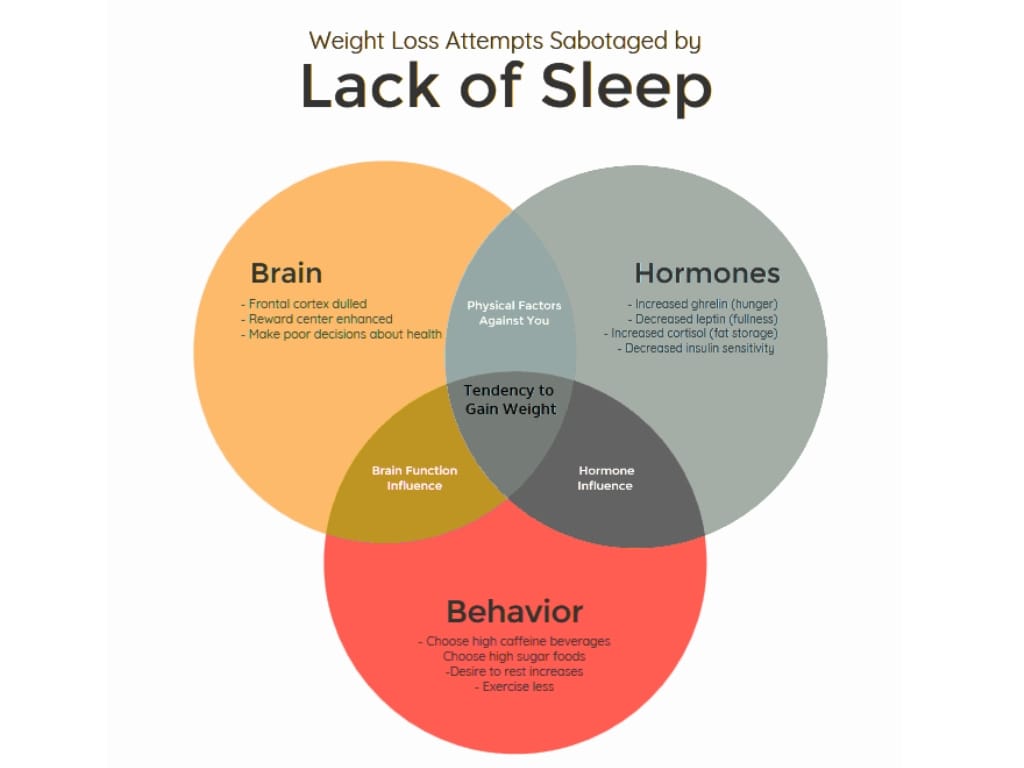
Leptin (satiety hormone) and ghrelin (hunger hormone) normally follow a healthy rhythm overnight. When sleep is shortened or irregular, leptin levels fall while ghrelin rises — increasing hunger, reducing fullness, and driving cravings for calorie-dense foods.
Clinically, this explains why patients with disrupted sleep often report:
- Increased evening snacking
- Strong cravings for sugar or refined carbohydrates
- Difficulty sustaining dietary changes despite motivation
Circadian disruption also impairs insulin sensitivity, meaning glucose is handled less efficiently by cells — a key pathway linking poor sleep to type 2 diabetes risk.
Cortisol adds another layer. Normally high in the morning and low at night, cortisol becomes dysregulated when sleep timing is poor. Elevated evening cortisol — often driven by late stress, screens, or poor sleep hygiene — promotes visceral fat storage and further disrupts sleep quality.
Optimal Sleep Timing for Fat Metabolism
From a metabolic perspective, the most supportive sleep pattern is one that aligns with human biology: sleeping during the biological night and being active during daylight hours.
Studies consistently show that individuals who eat and sleep later — even with identical calorie intake — tend to:
- Burn less fat
- Store more energy as fat
- Show poorer glucose and lipid regulation
Late chronotypes (“night owls”) often demonstrate reduced fat oxidation compared to early sleepers, largely due to extended activity and eating into the biological night.
For most adults, a consistent sleep window roughly between 10–11 pm and 6–7 am supports optimal metabolic rhythm, though individual variation exists. At The Health Suite, we often assess sleep timing alongside metabolic markers such as insulin, HbA1c, cortisol patterns, and body composition to personalise recommendations.
Less Sleep, Less Fat Loss: What the Evidence Shows
One of the most clinically relevant findings comes from controlled weight-loss trials. In a landmark study, participants on identical calorie-restricted diets lost similar total weight, but sleep duration dramatically changed what they lost.
- Adequate sleep (~8.5 hours): greater fat loss
- Short sleep (~5.5 hours): 55% less fat loss and 60% more muscle loss
In other words, sleep-deprived individuals lost weight in a metabolically unfavourable way.
From a clinical standpoint, this reinforces that sleep is not optional in fat-loss or metabolic programmes. Without adequate sleep, the body shifts into energy conservation mode — burning less fat, increasing hunger, and preserving fat stores.
Practical Sleep Strategies We Often Recommend
At The Health Suite, sleep optimisation is often addressed alongside nutrition, movement, and diagnostics. Evidence-based strategies include:
- Consistent sleep and wake times, including weekends
- Morning daylight exposure, ideally outdoors
- Earlier evening meals, avoiding heavy late-night eating
- Reducing evening screen exposure to protect melatonin
- Daytime physical activity, avoiding intense late-evening exercise
- Adequate sleep duration (7–9 hours for most adults)
For individuals struggling despite lifestyle changes, further assessment — including cortisol rhythm testing, metabolic blood markers, or sleep evaluation — may be appropriate.
Final Thought
Sleep is not passive recovery — it is active metabolic regulation. By aligning your sleep timing with your circadian biology, you support fat oxidation, appetite control, insulin sensitivity, and long-term metabolic health.
At The Health Suite Leicester, we view sleep as a foundational clinical intervention — not a wellness add-on — because when sleep improves, everything downstream tends to follow.