How MCT-grade PRP works — the science behind your hair regrowth
- Published:
- Last medically reviewed:
You’ve probably come across PRP — Platelet-Rich Plasma — if you’ve researched hair loss. It’s been one of the most useful non-surgical treatments of the last decade: evidence-based, autologous (drawn from your own blood), and well-studied (Alves and Grimalt, 2018).
But PRP isn’t the finishing line. It’s the starting point.
At The Health Suite Leicester, every PRP treatment is now delivered as MCT-grade PRP — still your own blood, still autologous, still safe, but processed through a medical-grade system that significantly amplifies what it does. This blog explains how it works, and why we made it our standard of care.
How hair grows
Hair grows in a cycle. Each follicle has an active growth phase (anagen), a brief shutdown phase (catagen), and a resting phase (telogen) before the hair sheds and a new one starts. Healthy hair spends most of its time in the active phase.
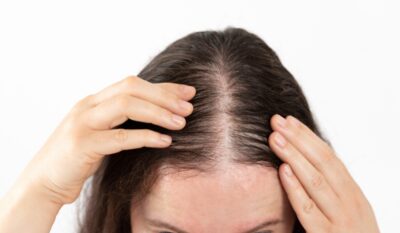
In pattern hair loss — the most common type, affecting both men and women — that growth phase shortens over time and the follicle itself slowly shrinks. The thick hair you used to grow becomes finer and weaker, and eventually stops. Hormones, blood supply changes, and inflammation around the follicle all play a part (Panahi et al., 2015).
A follicle isn’t a one-way machine. It’s constantly listening to chemical signals from the cells around it. The right signals keep it active. Without them, it shrinks. The local blood supply matters too — follicles are hungry tissue (Zhou et al., 2023).
That’s where PRP comes in.
What PRP does, and why it works
Inside every platelet in your blood is a tiny package of regenerative proteins called growth factors. When platelets are activated — at a wound, or during a PRP injection — they release these proteins (Blair and Flaumenhaft, 2009). Each one has a specific job:
- PDGF wakes up dormant follicle stem cells and triggers new blood vessel growth (Gonzalez et al., 2017)
- VEGF drives the formation of new capillaries — the tiny blood vessels that feed each follicle
- IGF-1 pushes follicles back into the active growth phase and protects them from dying off (Zhang et al., 2025)
- EGF and TGF-β help control the hair growth cycle itself
- FGF-2 and HGF support the cells that build the actual hair shaft (Ren et al., 2024)
PRP works by concentrating these growth factors several times above their normal level in your blood, then injecting them directly into the scalp where the follicles need them.
The evidence is strong. Multiple high-quality studies — pooled together in meta-analyses — show measurable improvements in hair density compared with placebo (Evans et al., 2022; Gupta et al., 2020; Gressenberger et al., 2023). Across the last decade, PRP has been a genuinely effective treatment for thousands of patients.
Standard PRP has a ceiling, though. You’re working with whatever your platelets happen to contain that day, processed through a single spin in a centrifuge. For someone with advanced thinning, or for anyone wanting the strongest possible response from their own biology, there’s room for more.
What MCT processing adds
MCT is a medical-grade processing system, certified to Class IIa under European medical device regulations. It’s an additional processing step in PRP preparation — same blood draw, same overall process — using a sealed sterile single-use kit that significantly amplifies what’s in the final preparation before it reaches your scalp.
Independent peer-reviewed analysis comparing MCT-processed PRP to standard PRP shows three meaningful changes:
- Approximately 3× the growth factors — the PDGF, VEGF, IGF-1 and TGF-β proteins your follicles respond to
- Approximately 2× the ATP — adenosine triphosphate, the molecule your cells use as energy. Tired or struggling follicles are often running on empty, and giving them more cellular fuel alongside the regenerative signals is a logical advantage
- A substantially higher yield of your own exosomes — and these need a section to themselves.
Exosomes — what they are, and why this matters
Exosomes are tiny vesicles released by almost every cell in your body — around a thousand times smaller than a red blood cell. For decades they were thought to be cellular waste. We now know they’re one of the body’s main communication systems, carrying proteins, lipids and genetic messages between cells like microscopic letters (Yang et al., 2023; Zhou et al., 2023).
In hair follicles, the right kind of exosome can switch dormant follicles back on (Hu et al., 2025; Gentile and Garcovich, 2023). That’s why exosomes have become such a focus in regenerative medicine.
Two completely different things are being called “exosome therapy” in UK aesthetics, and they aren’t the same.
Donor-derived or commercial exosome products come from outside your body — cultured stem cells, umbilical cord tissue, or other sources. The MHRA considers these medicinal products under the Advanced Therapy Medicinal Products framework, and no such product currently has UK marketing authorisation for aesthetic use (Prasanna et al., 2025; Save Face, 2025). Clinics injecting them are operating outside the regulatory framework, and there has been recent press coverage of exactly that.
Autologous exosomes — your own — are different. They’ve always been in your blood; they came from your cells. When MCT-grade PRP includes a higher concentration of your own exosomes, no external product is added. Nothing is being injected that wasn’t already part of you. This sits within the same well-established UK framework that has covered standard PRP safely for over a decade.
In marketing copy the two often get blurred. In regulatory and safety terms, they couldn’t be more different.
One question is worth asking any clinic offering “exosome therapy”: autologous, from my own blood, processed today — or donor-derived? In the UK, the safe and legal answer is always autologous. That’s exactly what MCT-grade PRP is.
Why we made MCT our standard, not an upgrade
Many clinics introduce a technology like this as a premium tier. Standard PRP at one price, “Advanced” or “Enhanced” PRP at a higher price, and you’re asked to choose at consultation. We considered that approach and rejected it.
If we have two safe, legitimate autologous options available — one biologically stronger, one weaker — there isn’t a clinical case for ever giving you the weaker one as a default. We’d rather price honestly for what we believe is best practice than offer a cheaper version we ourselves wouldn’t choose.
That’s why our pricing is visibly higher than basic PRP at non-specialist clinics. What you’re paying for is the medical-grade processing system, the doctor-designed protocol, the U225 delivery method, and a clinical commitment not to compromise on autologous quality. It’s also why we don’t run discount offers on PRP — your standard of care shouldn’t fluctuate with the calendar.
Delivery is half the story
There’s no point preparing a powerful autologous serum if it goes in at the wrong depth, in the wrong place, or in painful manual injections that leave the scalp inflamed.
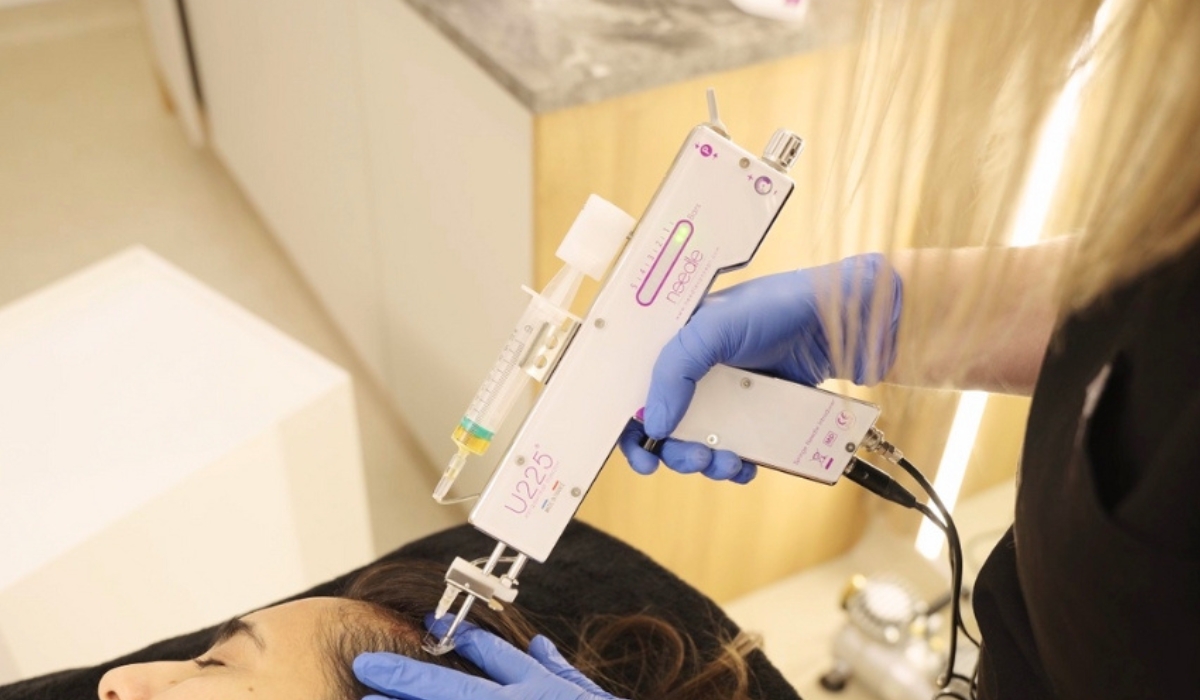
We deliver every MCT-grade PRP treatment using the U225 — an electropneumatic intradermal injector that performs hundreds of micro-precise injections at a controlled depth of 1–4 mm, exactly where follicles live. Most patients describe the sensation as a rhythmic tapping, more like a scalp massage than what you might expect from injections. There’s more on the U225 in our existing article on PRP and the U225 Meso Gun.
Where the evidence stands
The evidence base for PRP itself is mature and strong, established across multiple meta-analyses. The clinical outcome data specifically for MCT-processed PRP is younger and smaller, simply because the technology is newer. The biological rationale is solid, the safety profile is identical to standard PRP, and what we’re seeing in our own clinic is encouraging — but I won’t dress that up as a finished body of evidence.
MCT-grade PRP also amplifies a treatment that already works. It doesn’t replace good clinical assessment, and it can’t fix things that aren’t really PRP problems. Iron deficiency, low vitamin D, untreated thyroid disease, hormonal imbalances — these all cause hair loss too, and the strongest PRP in the world can’t out-run them.
Every hair restoration consultation at The Health Suite begins with a full clinical history, scalp examination, and where appropriate, blood tests. It’s where good results come from.
Next steps
If you’re considering MCT-grade PRP for hair loss, the next step is a consultation. We’ll examine the scalp properly, take a clinical history, review any blood results, and tell you honestly what we think the right plan is — including whether MCT-grade PRP is the right starting point for you, or whether there are foundations to address first.
Advanced MCT-Grade Platelet-Rich Plasma (PRP) Therapy for Hair Loss
Struggling with pattern baldness or thinning hair? Access medical-grade PRP hair loss treatments in Leicester.