The next generation of PRP — and why every Health Suite patient gets it
- Published:
- Last medically reviewed:
At The Health Suite, we continually evaluate new developments in regenerative and integrative medicine. The clinic was built on a specific principle: that good private practice should bring genuine clinical advances to patients quickly, with the rigour to recognise which advances earn their place. Most new technologies don’t make the cut. Some do.
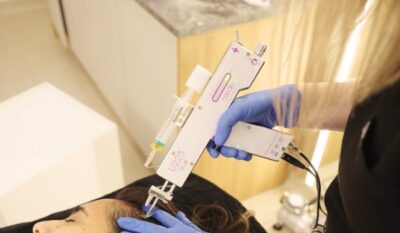
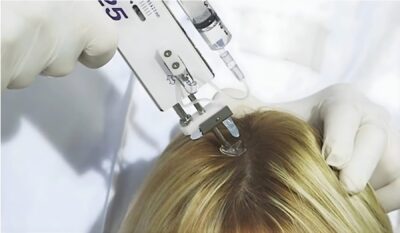
The MCT System — a Class IIa Medical CE-certified autologous processing technology — is the latest to do so, joining established Health Suite treatments such as Hyperbaric Oxygen Therapy, the U225 micro-injection delivery system, and Red-Light PBM photobiomodulation.
Platelet-Rich Plasma has been one of the genuine successes of regenerative aesthetic medicine. For over a decade, it has helped thousands of patients with hair loss, working entirely with the patient’s own biology — autologous, safe, and well-evidenced (Alves and Grimalt, 2018; Evans et al., 2022; Gupta et al., 2020). What MCT changes is what we can do with the same blood draw.
What MCT processing changes, clinically
The MCT System adds a validated additional step to PRP preparation. The blood draw is unchanged. The delivery to the scalp is unchanged. What changes is what’s in the syringe.
Independent peer-reviewed analysis comparing MCT-processed and conventional PRP shows three meaningful differences:
- Approximately 3× the growth factor yield — the PDGF, VEGF, IGF-1 and TGF-β proteins driving follicular activation (Gonzalez et al., 2017; Zhang et al., 2025)
- Approximately 2× the ATP content — the cellular energy currency that recovering follicles need
- A substantially higher yield of autologous exosomes — the patient’s own intercellular signalling vesicles, drawn from their own blood
For the same blood draw, the prepared serum returned to the scalp contains a more meaningful biological signal. The mechanism of action of PRP is driven by those signals (Panahi et al., 2015; Ren et al., 2024). Amplifying them is mechanistically coherent with a stronger therapeutic effect.
I’ll be direct about what is and isn’t established. The PRP evidence base is mature: multiple randomised controlled trial meta-analyses demonstrate statistically significant improvements in hair density (Evans et al., 2022; Gupta et al., 2020; Gressenberger et al., 2023). The MCT-specific clinical outcome evidence base is newer and smaller, as is always the case with recently introduced technologies (Hu et al., 2025). What I can say is that the mechanistic biology is sound, the autologous safety profile is identical to standard PRP, and the early clinical signal in our own practice is consistent with the published rationale.
Why MCT earned its place
The reason MCT became part of how we deliver PRP is straightforward: it gives patients more from the same blood draw. More growth factors, more cellular energy, more of their own regenerative signals reaching the follicles that need them. For patients with advanced thinning, post-transplant recovery needs, or anyone seeking the strongest autologous response their body can provide, that difference matters.
Each treatment is processed in a single sealed sterile single-use kit, on-site, in the same clinical encounter as the blood draw. This keeps the entire procedure within the well-established UK autologous therapy framework that has covered PRP safely for over a decade. It is fundamentally different from the donor-derived “exosome therapy” products that have attracted regulatory attention recently — those are imported or culture-derived medicinal products without UK marketing authorisation for aesthetic use (Prasanna et al., 2025; Save Face, 2025). MCT-grade PRP uses no external product. It uses your blood, processed in our clinic, and returned to you in the same session.
Why we made it standard for every patient
The most common way new aesthetic technologies enter UK practice is as a paid-for upgrade tier — sitting alongside the existing default for patients who choose to spend more.
We took a different approach. Rather than offer MCT-grade processing as a premium tier, we made it the standard preparation for every PRP treatment we deliver, across every hair restoration package — Revive, Restore, Renew and Regenerate. Every Health Suite hair patient receives the same clinical standard, regardless of which package they choose.
If a clinical advance is genuinely better, it should not be reserved for patients who choose to pay extra. Offering it as standard is more aligned with how doctor-led private practice should work.
This is reflected in our pricing, which is visibly higher than basic PRP at non-specialist clinics. What that price covers is the Class IIa Medical CE-certified processing system, the doctor-designed protocol, the U225 delivery method, and our consistent commitment not to compromise on autologous quality. We don’t run discount offers on MCT-grade PRP. Standard of care should not fluctuate with the commercial calendar.
Foundations still matter
MCT-grade PRP is a more powerful regenerative signal. It is not, and was never going to be, a substitute for proper clinical assessment.
Every hair restoration consultation at The Health Suite begins with a full clinical history, scalp examination, severity grading, and where appropriate, a blood review: ferritin, vitamin D, thyroid function, sex hormones. Iron deficiency in particular is strikingly prevalent in women presenting with hair loss — a 2022 meta-analysis of over 10,000 participants found significantly lower ferritin in women with non-scarring alopecia compared with controls (Treister-Goltzman and Peleg, 2022). No regenerative treatment, however biologically powerful, can out-run an untreated ferritin of 14 μg/L (Olsen et al., 2010).
This unglamorous foundational work is part of what defines The Health Suite’s approach to hair restoration, and it has not changed.
What's next
MCT joins a programme of ongoing clinical development at The Health Suite. We continue to evaluate emerging technologies in regenerative aesthetics, functional medicine and longevity science.
For patients reading this who are considering hair restoration: the next step is a consultation. We’ll examine your scalp, take a clinical history, review any blood results, and tell you honestly what we believe the right plan is.
Advanced MCT-Grade Platelet-Rich Plasma (PRP) Therapy for Hair Loss
Struggling with pattern baldness or thinning hair? Access medical-grade PRP hair loss treatments in Leicester.