Invisible — a woman’s story of hair loss, identity, and the quiet science of getting it back
- Published:
- Last medically reviewed:
She noticed it in the shower first, the way most women do.
A few more strands twisted around her fingers when she rinsed out the conditioner. She told herself it was the stress of her son’s GCSEs. Or the new job. Or the long summer.
She was forty-seven, and she had always had good hair.
Six months later, she was standing in front of her bathroom mirror at half past six in the morning, holding a fistful of her own hair up to the light, and crying quietly so she would not wake her husband.
The numbers nobody mentions
Female hair loss is far more common than most women realise. By age sixty, around 35% of women show clinical signs of androgenetic hair loss (Cranwell and Sinclair, 2023). For perimenopausal and menopausal women the figure is higher. Postpartum shedding affects almost every new mother to some degree. And underlying drivers — iron deficiency, low vitamin D, thyroid imbalance — are extraordinarily common: a 2022 systematic review of over 10,000 participants found women with non-scarring hair loss had significantly lower ferritin levels than controls (Treister-Goltzman and Peleg, 2022).
Yet female hair loss is spoken about almost nowhere.
Most high-street advertising about hair loss is aimed at men. NHS guidance is — quite reasonably — focused on excluding serious causes rather than restoring density. Friends offer a sympathetic “oh, mine’s been awful too” and change the subject. Women are left to Google at half past six in the morning.
Why female hair loss is different
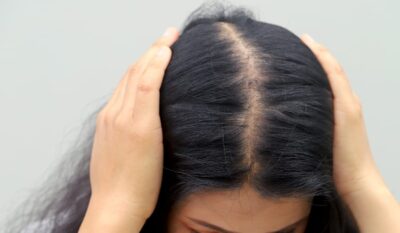
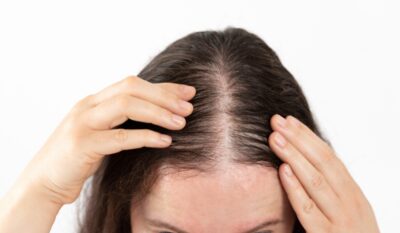
Medically, female pattern hair loss does not usually look like male pattern baldness. It tends to present as a diffuse thinning across the crown and mid-parting, with the frontal hairline preserved (Cranwell and Sinclair, 2023). The mechanism is rarely a single cause. It is more often a combination — a hormonal shift through perimenopause, ferritin levels that have drifted below the threshold the follicle needs, slightly underactive thyroid function, and genetic predisposition (Carmina et al., 2019).
Emotionally, it is different too. Hair is so woven into identity — femininity, youth, vitality — that thinning can carry a weight wildly out of proportion to its visibility. Women describe feeling invisible long before anyone else has actually noticed.
They stop having photographs taken. They change their parting. They rotate through three new shampoos a year. They avoid the rear-view mirror in good lighting.
The first consultation
When she came to The Health Suite for the first time, she had rehearsed what she would say in the car.
She had braced herself for being told it was just her age. She need not have.
The clinician did what a proper medical consultation does: took a full history, looked at her scalp in good light, asked about her periods, her sleep, her energy, her diet, her recent bloods. None of it was rushed.
Then came the tests. Ferritin — low. Vitamin D — low. Thyroid — borderline. Testosterone and DHEA-S — within normal range, but towards the upper end. A clear pattern, not a single cause.
What came first
Addressing the foundations came first. An iron infusion. Vitamin D supplementation. A conversation with her GP about thyroid monitoring. Nutritional therapy input.
None of this was glamorous. None of it was a syringe or a beam of light. All of it mattered, because the most advanced regenerative treatment in the world cannot out-run a ferritin of 14 μg/L (Olsen et al., 2010).
This is the part of female hair restoration that almost no advertising mentions. It is also the part that decides whether the rest of the treatment plan will work.
And then — only then — the regenerative work
Three months in, with the underlying drivers properly addressed, the regenerative programme began. Every PRP treatment at The Health Suite is now delivered as MCT-grade — a Class IIa Medical CE-certified autologous processing system that significantly amplifies the regenerative content of a patient’s own blood before it returns to the scalp.
For a woman whose follicles had been quietly starved for years, this was the kind of biological signal they needed.
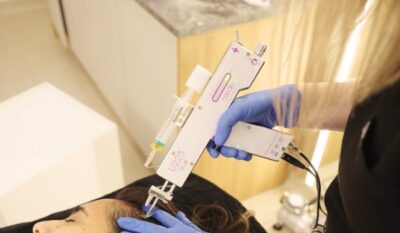
The treatment itself surprised her. The U225 micro-injector made the experience quiet and rhythmic — closer to a scalp massage than what she had imagined. She went back to work that afternoon.
Nothing happens overnight in hair restoration. Worth saying clearly: nothing.
The first sign — two months in — was that her hair stopped coming out in handfuls in the shower. Then, gradually, the regrowth appeared. Shorter, finer hairs at the parting. Then thicker. By month six, she had moved her parting back to where it used to live.
What she said afterwards
Patients in this situation tend to say very similar things, almost word for word.
They do not talk about hair. They talk about feeling present again. About enjoying photographs. About not dreading the lighting in certain rooms. About being able to put their hair up without the small daily act of concealment.
Sometimes they talk about their husbands or partners noticing the confidence before they notice the hair.
It is easy, in any field of medicine that involves visible results, to focus on the procedure and forget the reason anyone walks through the door. Women do not come to our clinic for platelets and growth factors. They come because they have been feeling invisible for months, and they would like to feel like themselves.
What we want every woman reading this to know
- Female hair loss is a medical concern, not a vanity. It deserves a proper clinical workup — full history, scalp examination, and the right blood tests.
- It is almost never just one cause. Hormones, iron, vitamin D, thyroid, stress, genetics — usually in combination (Cranwell and Sinclair, 2023; Carmina et al., 2019).
- Regenerative treatment works best when the foundations are addressed first. There is no shortcut around bloods.
- At The Health Suite, every PRP treatment is delivered as MCT-grade by default — the most advanced autologous preparation we offer, available to every patient as standard.
- Early intervention produces the best results. You do not need to wait until you are in crisis.
A consultation is the next step
Our doctor-led hair restoration consultations are unhurried. We will examine the scalp, take a clinical history, review any blood tests, and tell you honestly what the right plan is — including whether the foundations need addressing first, before any regenerative treatment.
If you suspect perimenopause or menopause may be part of the picture, our Menopause Clinic can address the wider hormonal landscape alongside the hair work.
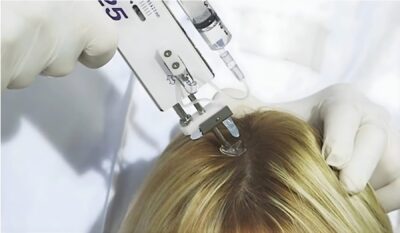
Advanced MCT-Grade Platelet-Rich Plasma (PRP) Therapy for Hair Loss
Struggling with pattern baldness or thinning hair? Access medical-grade PRP hair loss treatments in Leicester.

Women’s Hormone Blood Tests
Private Women's Hormone Blood Tests in Leicester. Fast, accurate laboratory tracking for oestrogen, progesterone, LH, FSH, and endocrine wellness.

Menopause Clinic
The Menopause Clinic at The Health Suite Leicester - Doctor-Led specialised Menopause Care by a British Menopause Society Accredited expert.