
Grounding and Earthing: What the Science Says and How to Build It Into Daily Life
- Published:
- Last medically reviewed:
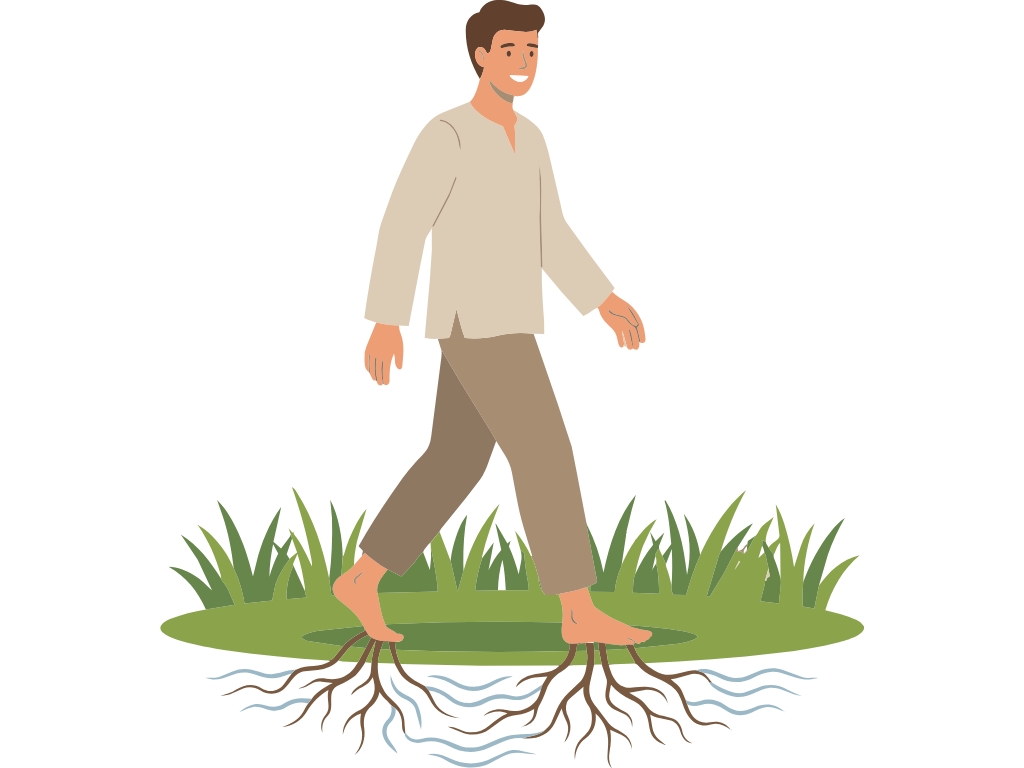
Of all the health practices that have attracted renewed scientific interest in recent years, grounding, sometimes known as earthing, is perhaps the one that most challenges the assumption that effective health interventions must be complex or expensive. The practice involves direct physical contact between the human body and the surface of the earth, whether through walking barefoot on grass, soil or sand, swimming in natural bodies of water, or using conductive mats and sheets designed to replicate the electrical connection that direct contact with the ground provides.
The idea that physical contact with the earth might have measurable biological effects sounds, on first encounter, more like ancient wisdom than clinical science. But the physiological rationale is grounded, in the literal sense, in established electrochemistry. The earth’s surface carries a continuous and virtually limitless supply of free electrons, maintained by the global atmospheric electrical circuit and the constant discharge of lightning strikes worldwide.1
The human body, when in direct conductive contact with the earth, can absorb these electrons through the skin. It is this electron transfer, and its downstream effects on oxidative stress, inflammation and bioelectrical function, that forms the mechanistic basis of grounding research.
-
What Is The Science Behind Grounding?
The biological benefits of grounding rest on the relationship between free electrons and oxidative stress. Free radicals, the reactive oxygen species produced as a byproduct of normal metabolism and in greater quantities during illness, injury and chronic stress, are electron-deficient molecules that stabilise themselves by stripping electrons from surrounding tissues, causing cellular damage in the process.2
Antioxidants, whether dietary or endogenous, function by donating electrons to neutralise free radicals before they cause harm. The hypothesis underlying grounding research is that the free electrons absorbed from the earth’s surface can function as natural antioxidants, reducing the oxidative burden on tissues in a manner analogous to dietary antioxidants but through a direct electrochemical pathway.
This is not merely theoretical, as a number of peer-reviewed studies have investigated the physiological effects of grounding using controlled experimental designs, and the findings across several research groups have been consistent enough to warrant serious attention. For example, a study published in the Journal of Environmental and Public Health found that grounding produced measurable reductions in markers of inflammation, pain and stress, and improvements in sleep quality and autonomic nervous system function in a sample of subjects with chronic pain and sleep disturbance. 3
Research published in the Journal of Alternative and Complementary Medicine demonstrated that grounding during sleep, using conductive bed sheets connected to the earth, produced significant reductions in cortisol levels and improvements in sleep architecture, mood and pain compared with a sham-grounded control group. 4 And a further study in the same journal found that grounding accelerated recovery from delayed-onset muscle soreness following exercise, with grounded subjects showing lower inflammatory markers and faster return to baseline muscle function than controls. 5
What Is The Relationship Between Grounding and Inflammation?
The anti-inflammatory effects of grounding are the most extensively studied aspect of the practice and the area where the rationale is strongest. Inflammation involves the migration of white blood cells to sites of tissue damage, where they generate reactive oxygen species as part of the immune response.
When the inflammatory response is acute and time-limited, this is an appropriate and necessary process. When it becomes chronic, the sustained generation of free radicals contributes to ongoing tissue damage and the progression of a wide range of conditions. Research using medical infrared imaging has documented reductions in facial inflammation following grounding sessions, providing visual evidence of the anti-inflammatory effect alongside biochemical markers.6
The proposed mechanism involves the neutralisation of reactive oxygen species at the site of inflammation by electrons absorbed from the earth, effectively quenching the oxidative component of the inflammatory response. Zeta potential, a measure of the electrical charge on the surface of red blood cells that influences their tendency to clump together, has also been found to increase with grounding, suggesting improvements in blood viscosity and microcirculation that may contribute independently to reduced inflammatory burden.7
For people managing chronic inflammatory conditions, grounding for inflammation represents a low-risk, zero-cost adjunct to conventional management that is biologically plausible and supported by a small but consistent body of research. It should not be positioned as a replacement for established treatment, but its integration into a broader lifestyle approach to managing inflammation is scientifically defensible.
What Is The Relationship Between Grounding and Sleep?
The relationship between grounding and sleep quality is one of the most practically significant findings in the earthing literature, and it operates through a specific and well-characterised pathway involving cortisol. Cortisol, the body’s primary stress hormone, follows a circadian rhythm that should produce peak levels in the early morning to support waking alertness and a progressive decline through the day to its lowest point around midnight, allowing the nervous system to enter the parasympathetic state conducive to sleep.
In people with chronic stress, sleep disruption or circadian misalignment, this cortisol rhythm is frequently flattened or shifted, with elevated evening cortisol levels directly interfering with sleep onset and sleep quality. A study published in the Journal of Alternative and Complementary Medicine found that grounding during sleep normalised the diurnal cortisol profile in subjects whose rhythm had been disrupted, with participants reporting significant improvements in sleep onset, sleep duration, daytime energy and mood.⁴
The mechanism is thought to involve the stabilising effect of Earth’s electrons on the autonomic nervous system, shifting the balance toward parasympathetic dominance and reducing the physiological arousal that disrupted cortisol patterns produce.
What Is The Relationship Between Grounding and Stress?
The stress-reducing effects of grounding overlap substantially with the sleep and inflammation benefits but are also supported by direct measurements of autonomic nervous system function. Heart rate variability, the variation in time between successive heartbeats that serves as a sensitive marker of autonomic balance and stress resilience, has been found to improve with grounding in several studies, indicating a shift toward greater parasympathetic tone.⁸
This is consistent with the subjective experience reported consistently by grounding practitioners, of a rapid and sometimes profound sense of calm and physical relaxation on making contact with the earth. While subjective reports are not themselves evidence of physiological effect, they are consistent with the objective autonomic data and with the known effects of spending time in natural environments on stress physiology more broadly.
The broader field of nature therapy, which encompasses forest bathing, blue space therapy and related practices, has produced a substantial evidence base demonstrating that contact with natural environments reduces cortisol, lowers blood pressure and improves mood through mechanisms that partially overlap with those proposed for grounding.⁹
What Is The Simplest Form of Grounding?
The most straightforward and cost-free approach to grounding is also the most intuitive: walking barefoot on natural surfaces. Grass, soil, sand and natural stone all provide conductive contact with the earth when the skin is in direct contact with them.
The health benefits of walking barefoot extend beyond the electrical connection to include sensory stimulation of the foot’s mechanoreceptors, strengthening of the intrinsic foot muscles, and improvements in gait mechanics and proprioception that are lost when the foot is permanently enclosed in footwear.¹⁰
For most people in the UK, opportunities for barefoot outdoor contact are seasonal and weather-dependent, which is a genuine practical limitation. However, even brief and regular periods of barefoot contact with natural ground surfaces, ten to twenty minutes on grass or soil on a dry day, are sufficient to produce measurable changes in surface electrostatic charge on the body and are consistent with the durations used in grounding research. Indoor applications using conductive grounding mats, which connect via a wire to the earth terminal of a standard electrical socket, provide a practical alternative for daily use regardless of weather or season.
How Can You Build Grounding Into Daily Life?
Grounding does not require a significant investment of time, money or lifestyle disruption to implement meaningfully. A daily habit of ten to twenty minutes walking or standing barefoot on grass, soil or sand, when weather permits, provides direct earth contact and the additional benefits of outdoor light exposure and physical activity.
For indoor and year-round use, grounding mats placed under a desk or beside a bed, and grounding sheets used during sleep, allow extended grounding sessions without any behavioural change beyond their initial setup. Swimming or paddling in the sea, rivers or lakes provides full-body grounding contact and combines the electrochemical benefits of earth connection with the well-documented physiological effects of cold water exposure. Simply sitting or lying on natural ground in a garden or park, with bare skin in contact with the surface, requires no equipment and no specific knowledge.
The consistency of contact matters more than the duration of individual sessions. A daily habit of modest duration is likely to be more beneficial than occasional extended sessions, given that the proposed mechanisms involve ongoing electrochemical equilibration between the body and the earth rather than a single acute event.
Grounding and Health at The Health Suite Leicester
Grounding is one expression of a broader principle that underpins much of the most compelling research in preventative health: that the natural environment, and our physical relationship with it, plays a meaningful role in maintaining the biological balance that good health requires. At The Health Suite Leicester, we take a comprehensive and evidence-informed approach to health that considers the full range of lifestyle, environmental and physiological factors shaping each individual’s health.
Our team of experienced clinicians provides personalised assessment and practical guidance across nutrition, stress management, sleep, inflammation and long-term health optimisation, helping you identify the changes most likely to make a meaningful difference to how you feel and function.
Take a More Proactive Approach to Your Health
Looking to improve your sleep, reduce stress and support long-term wellbeing? Our experienced team can help you build a personalised health and wellness plan. Book a consultation at The Health Suite Leicester today.