
What Is FRAT Testing for Children? Understanding Folate Receptor Antibody Testing
- Published:
- Last medically reviewed:
When a child is struggling developmentally, whether with speech and language, attention and behaviour, learning or social communication, the clinical pathway to understanding why can be long and frustratingly incomplete. Standard investigations often return normal results even when something is clearly not right, and the gap between a child’s difficulties and any identifiable explanation can leave families without a clear direction for treatment or support.
Folate receptor antibody testing (FRAT) has emerged as a clinically meaningful investigation for a select subset of children in whom impaired transport of folate into the brain may be contributing to neurodevelopmental difficulties. In the right clinical context, it can identify a specific and treatable mechanism that would otherwise remain undetected, and that distinction matters considerably for the children and families it affects.
-
What Is Cerebral Folate Deficiency and Why Does It Occur?
Folate, a natural form of vitamin B9, is essential for healthy brain development. It helps the brain produce important chemical messengers, supports normal genetic regulation, and plays a key role in how brain cells grow and function.1
The brain has particularly high folate requirements relative to other organs, and adequate folate transport into the central nervous system is critical for normal cognitive and neurological function throughout childhood and adolescence.
Folate is transported from the bloodstream into the brain via specialised folate receptors located on the choroid plexus, the structure responsible for producing cerebrospinal fluid (the fluid in and around the brain) and regulating the passage of nutrients into the central nervous system.
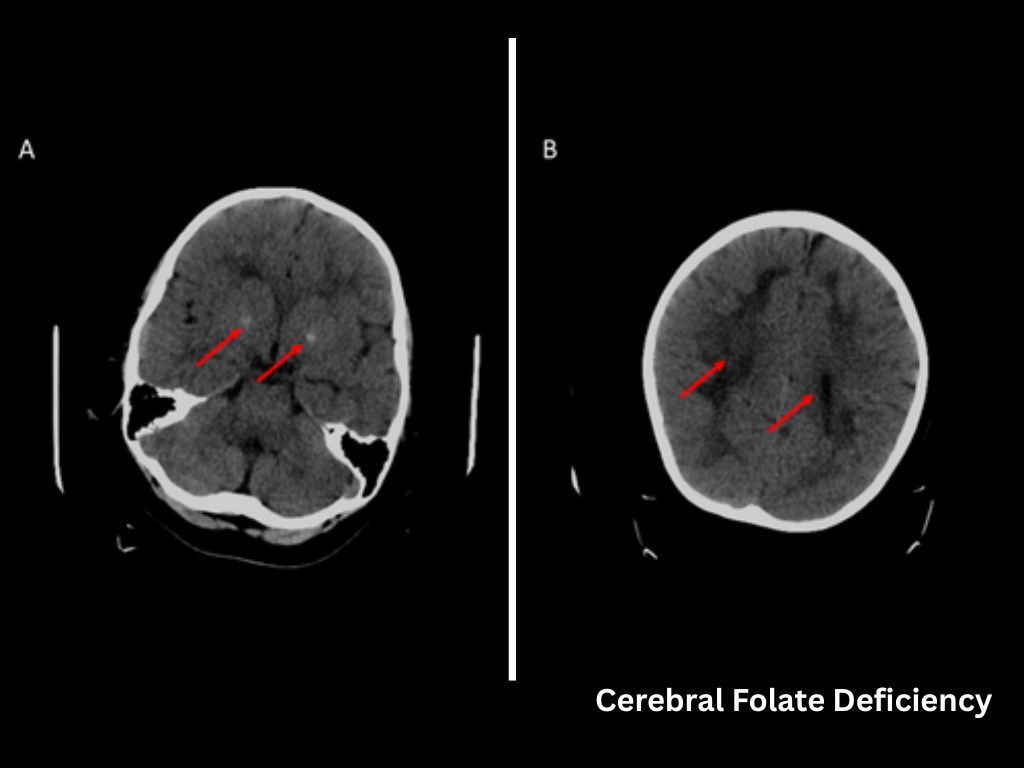
In most children, this transport system functions normally. In some, however, it is disrupted by the presence of autoantibodies – antibodies mistakenly produced by the immune system that target the body’s own tissues. 2
These autoantibodies, which the FRAT test is designed to detect, interfere with normal folate receptor function in two distinct ways:
- Blocking antibodies prevent folate from binding to its receptor, directly impeding transport into the brain.
- And binding antibodies attach to the receptor and reduce its functional capacity without fully blocking it, but with clinically significant consequences nonetheless. 3
The result in both cases is a state of cerebral folate deficiency – a condition in which the brain does not receive enough folate, even though standard blood tests may show normal folate levels. This is a critical point. A child with folate receptor antibodies may have normal or even elevated blood folate on routine testing, which would conventionally be interpreted as reassuring.
But if folate is not being transported effectively into the brain, normal blood levels are not a reliable indicator of cerebral folate status, and the functional deficiency within the central nervous system may be causing or contributing to significant neurodevelopmental difficulties that are not otherwise explained. 4
What Has The Research Found?
The role of folate receptor antibodies in children with neurodevelopmental conditions, such as autism and developmental delay, has been increasingly studied with findings consistent enough to inform specialist clinical practice. Research published in Molecular Psychiatry found antibodies present in a significant majority of children with autism examined, representing a substantially higher rate than observed in controls.5
Building on this, research published in Acta Neurologica Scandinavica identified folate receptor antibodies in children presenting with cerebral folate deficiency syndrome, a condition characterised by low cerebrospinal fluid folate alongside neurological and developmental symptoms including irritability, motor difficulties, speech regression and seizures.6 The association between folate receptor antibodies and broader neurodevelopmental presentations (for example, developmental delay, attention difficulties and behavioural dysregulation) has also been reported.⁷
Importantly, several studies have investigated the effect of treatment with high-dose folinic acid, a form of folate that bypasses the impaired receptor transport pathway, in children with folate receptor antibodies. A trial published in Molecular Psychiatry found that folinic acid supplementation produced significant improvements in verbal communication in children with autism who tested positive for folate receptor antibodies, with responders showing considerably greater benefit than those who were antibody-negative.7
Similarly, a case series published in Neurology documented meaningful developmental improvements in children with cerebral folate deficiency treated with folinic acid, including in children whose serum folate had appeared normal before diagnosis. 4 These findings are important because they suggest that FRAT testing can identify a subgroup of children for whom a specific, targeted intervention may deliver benefit, rather than offering non-specific treatment to all.
Who Is FRAT Testing Appropriate For?
FRAT testing is a specialist investigation rather than a general screening tool, and appropriate clinical selection is essential. The test is most likely to be informative and most likely to lead to beneficial intervention in children who meet specific clinical criteria that make the presence of folate receptor antibodies a likely contributor to their presentation.
Children who may be appropriate candidates include those with a confirmed or suspected diagnosis of autism spectrum condition, particularly where there are features suggestive of a biological or metabolic contributor alongside the core neurodevelopmental presentation.
For example, children with developmental delay affecting:
- Speech
- Language
- Cognition
- Or behaviour that has not been fully explained by standard assessment
It can also cover those with unexplained neurological symptoms, including:
- Regression
- Fatigue
- Or movement difficulties or seizures
A family history of autoimmune disease is also relevant, given that folate receptor antibodies are an autoimmune phenomenon and may be more prevalent in children with a broader autoimmune family background.² Children who have not responded as expected to standard nutritional support, or where there is clinical suspicion that the body may be having difficulty transporting or properly using folate, may also benefit from formal testing. 8,9
It is equally important to be clear about when FRAT testing is not indicated. It is not a first-line investigation for all children with developmental concerns, and it should not be pursued outside a consultant-led clinical framework that ensures appropriate selection, interpretation of results and management of findings.
A positive result for folate receptor antibodies requires careful clinical interpretation and, where treatment is indicated, medical oversight of the folinic acid dosing that represents the primary therapeutic response.
What Happens If the Test Is Positive?
A positive FRAT result, indicating the presence of blocking or binding folate receptor antibodies, does not in itself constitute a diagnosis. It identifies a specific biological mechanism, impaired folate transport into the brain, that may be contributing to a child’s difficulties, and that is potentially treatable.
The clinical significance of a positive result depends on the child’s full presentation, and its interpretation requires the kind of integrated assessment that a consultant paediatrician with specialist knowledge of this area is best placed to provide. Where treatment is clinically indicated following a positive result, high-dose folinic acid is the primary intervention, working through an alternative transport pathway to restore adequate folate delivery to the brain. 6,7
Treatment response varies between individuals and requires monitoring, and in some cases, additional interventions to address the underlying autoimmune process may be considered alongside supplementation. The treatment pathway is a medical one, not a supplement protocol, and the distinction is important for both safety and efficacy.
FRAT Testing at The Health Suite
At The Health Suite, FRAT (Folate Receptor Antibody) testing is offered as part of a consultant-led paediatric assessment pathway for children with neurodevelopmental, cognitive, or neurological concerns. Testing is only recommended following a thorough clinical assessment to determine whether it is appropriate for your child. All results are interpreted in the context of your child’s full developmental profile, medical history, and individual presentation rather than viewed in isolation.
Where FRAT testing identifies folate receptor antibodies and treatment is clinically indicated, our consultants are able to prescribe and monitor folinic acid therapy directly, providing the specialist medical oversight required throughout the treatment pathway. Follow-up consultations and ongoing monitoring are incorporated into the care plan, ensuring your child’s response to treatment is assessed carefully and adjustments are made where appropriate over time.
If your child has a neurodevelopmental diagnosis, unexplained developmental difficulties, learning or behavioural concerns, or neurological symptoms that have not been fully explained through standard investigations, our consultant paediatric team can assess whether Folate Receptor Antibody (FRAT) testing may be appropriate. The first step is a comprehensive consultant-led paediatric assessment at The Health Suite Leicester, with support available for families across the UK.
Book your consultation today and take the next step towards understanding your child's health.
Concerned about your child’s development, behaviour or unexplained symptoms? Our consultant-led paediatric team can assess whether FRAT testing is appropriate and guide you through the next steps.

Folate Receptor Antibody (FRAT) Testing for Children
Consultant-led Folate Receptor Antibody (FRAT) testing for children. Supporting families across the UK.