
Could Folate Transport Issues Be Affecting Your Child? Signs to Watch For
- Published:
- Last medically reviewed:
When a child is not developing in the way their parents expect, the experience of trying to find answers is frequently one of the most exhausting things a family can face. Appointments accumulate, assessments are completed, and yet the results often come back unremarkable. And still, something is clearly not right.
For a subset of these children, the explanation may lie not in whether they are getting enough folate in their diet, but in whether folate is reaching the brain in adequate amounts. Folate receptor antibodies, autoimmune proteins that interfere with the transport of folate from the bloodstream into the central nervous system, can produce a state of functional cerebral folate deficiency even in children whose blood folate levels appear entirely normal on standard testing.
The brain is being deprived of a nutrient it needs for development and function, but the most commonly ordered tests do not indicate that anything is wrong. Understanding which signs may point toward a folate transport problem, and which children are most likely to benefit from specialist investigation, is a key clinical question for parents and clinicians navigating unexplained developmental difficulties.
-
Why Does Folate Matter So Much For The Developing Brain?
Folate is a nutrient with continuous and critical functions in the brain throughout childhood and adolescence. It is essential for the synthesis of neurotransmitters, including dopamine and serotonin, for DNA methylation processes that regulate gene expression in neural tissue, and for the production and maintenance of the myelin sheath that enables efficient nerve signal transmission.1
The brain’s demand for folate is disproportionately high relative to other organs, and the transport system that delivers it across the blood-brain barrier must function efficiently to meet that demand. This transport system depends on folate receptors located on the choroid plexus, the structure within the brain that produces cerebrospinal fluid.
When autoantibodies target these receptors, folate delivery into the central nervous system is compromised regardless of how much folate the child is consuming or how well it is absorbed in the gut.2
Serum folate levels, the standard measure used in routine blood testing, reflect what is circulating in the bloodstream rather than what is reaching the brain, which is why a normal result does not rule out cerebral folate deficiency in a child whose receptors are being blocked by antibodies.3
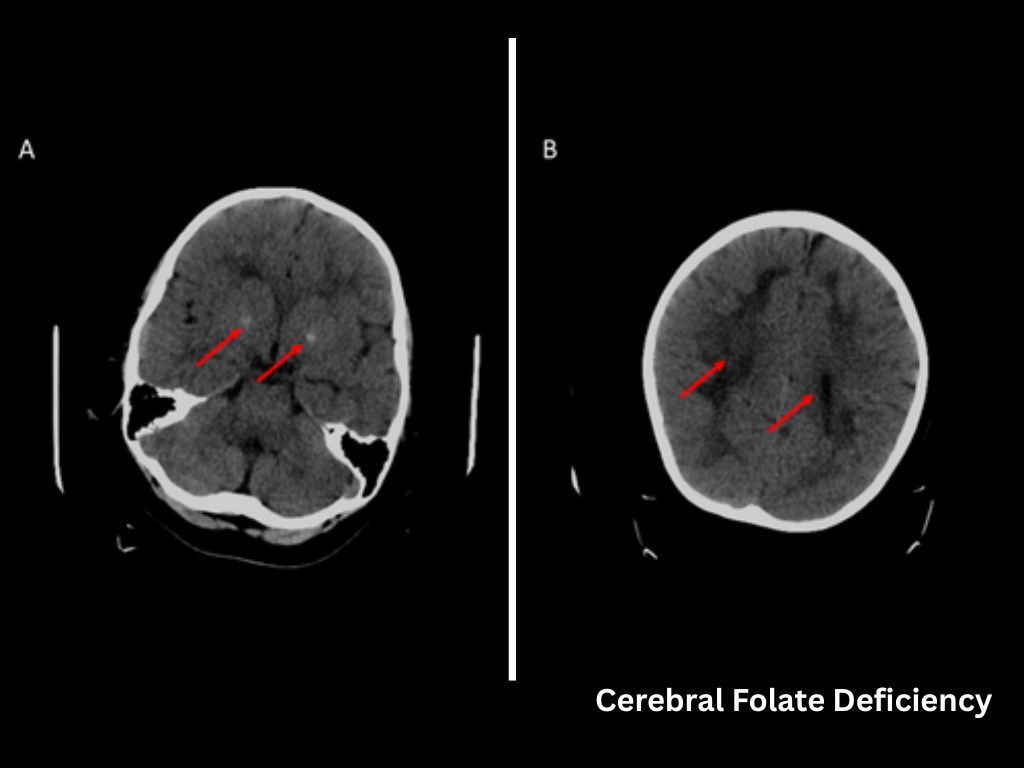
What Signs Might Indicate A Folate Transport Problem?
The signs associated with impaired cerebral folate transport are sometimes neurological and developmental in nature, reflecting the brain regions and processes that depend most heavily on adequate folate supply.
They are not specific to folate transport issues alone, which is part of why the condition is underdiagnosed, but certain patterns and combinations of symptoms are sufficiently characteristic to raise clinical suspicion and warrant further investigation.
Is Your Child’s Speech And Language Falling Behind?
Speech and language development is one of the most folate-sensitive aspects of early childhood neurodevelopment. Delays in acquiring first words, difficulty stringing words into sentences at the expected developmental stage, or a regression in previously acquired language skills are all presentations that have been associated with cerebral folate deficiency in the research literature.⁴
Language regression in particular, where a child who was developing normally loses words or communicative ability they previously had, is a clinical feature that should always prompt thorough investigation, and folate transport status is a meaningful part of that picture.
Could Autism Spectrum Features Point To A Folate Transport Issue?
The association between folate receptor antibodies and autism spectrum conditions is one of the most studied aspects of the FRAT literature. Research published in Molecular Psychiatry found folate receptor antibodies present in a significant majority of children with autism examined, at rates considerably higher than in neurotypical controls.5
It is important to note that not every child with autism has folate receptor antibodies, and not every child with folate receptor antibodies has autism. But in children with an autism diagnosis or with features suggestive of autism spectrum presentation, particularly where there are also signs of biological or metabolic contributors alongside the neurodevelopmental profile, folate receptor antibody status is a clinically relevant investigation.6
Are Attention, Concentration And Learning Difficulties Going Unexplained?
Folate plays a direct role in the synthesis of dopamine and noradrenaline, the neurotransmitters most centrally involved in attention regulation and executive function.1 Children with cerebral folate deficiency may present with difficulties sustaining attention, organising tasks, following instructions or retaining new information that superficially resemble attention deficit hyperactivity disorder but that have an underlying nutritional mechanism.
Where attention and learning difficulties have not responded as expected to standard educational or behavioural support, and particularly where they occur alongside other features on this list, folate transport status warrants consideration.
Is Your Child Showing Disproportionate Behavioural Difficulties?
Irritability, emotional volatility, low frustration tolerance and behavioural difficulties that appear disproportionate to circumstances and that are not explained by environmental factors alone can reflect the neurochemical consequences of inadequate folate availability in the brain.⁷
Serotonin synthesis in particular is folate-dependent, and impaired serotonergic signalling is associated with the kind of mood instability and behavioural dysregulation that parents of affected children frequently describe as one of their most disruptive and difficult-to-manage concerns.
Could Persistent Fatigue Be More Than Tiredness?
Fatigue in children that is persistent, present regardless of sleep quality and not explained by physical illness or anaemia is a recognised but underappreciated feature of cerebral folate deficiency.
The metabolic demands of neurotransmitter synthesis and cellular energy production in the brain are folate-dependent, and when those demands are not being met, the result can be a pervasive low-energy state that affects the child’s engagement, motivation and capacity for learning and social interaction.⁸
Are Motor Difficulties or Coordination Problems Present?
Difficulties with gross or fine motor coordination, clumsiness, unusual gait or delayed acquisition of motor milestones can reflect impaired myelination and cerebellar function associated with folate deficiency in the central nervous system.⁴
In children with cerebral folate deficiency syndrome specifically, a more severe form of the condition, motor regression and ataxia are recognised clinical features alongside the neurodevelopmental and behavioural presentation. Where motor difficulties occur alongside cognitive, behavioural or communicative concerns, the clinical picture is more suggestive of a systemic neurological contributor and warrants specialist assessment.
Are There Neurological Symptoms Without A Clear Cause?
Seizures, involuntary movements, sensory sensitivities or other neurological symptoms that have occurred without an identified structural or metabolic cause should prompt consideration of cerebral folate status, particularly in children with a family history of autoimmune disease.⁹
Folate receptor antibodies are an autoimmune phenomenon, and children born into families with autoimmune conditions, including thyroid disease, rheumatoid arthritis, coeliac disease or type 1 diabetes, may carry an elevated risk of developing them.²
Why Does A Normal Blood Folate Result Not Rule This Out?
It bears repeating, because it is the aspect of this condition most likely to result in missed diagnoses, that a normal serum folate result does not exclude cerebral folate deficiency. The FRAT test does not measure folate levels. It detects the autoantibodies that impair folate transport into the brain, which is an entirely different clinical question that standard blood testing does not address.³
A child can have optimal dietary folate intake, normal absorption, and normal blood levels, and still have significant cerebral folate deficiency if their receptor transport system is being blocked by autoantibodies. This is why the clinical history and symptom pattern matter as much as the test result in isolation, and why FRAT testing should always be conducted within a consultant-led assessment framework that can interpret a positive result in the full context of the child’s presentation.
Paediatric FRAT Testing At The Health Suite
If you recognise any of the signs described in this article in your child, whether a formal diagnosis is already in place or you are still searching for an explanation for difficulties that have not yet been fully understood, a specialist paediatric assessment may be the appropriate next step.
At The Health Suite, we support families across the UK with consultant-led paediatric FRAT testing as part of a comprehensive assessment pathway overseen by our Consultant Paediatricians. FRAT testing is only recommended following a thorough clinical assessment to determine whether it is appropriate for your child’s specific symptoms, developmental profile, and medical history.
Results are interpreted in the full context of your child’s developmental and medical history, providing families nationwide with expert guidance and a clear understanding of the findings. Where folate receptor antibodies are identified and treatment is indicated, we are able to prescribe and monitor folinic acid therapy directly, ensuring the management pathway is professionally supervised from assessment through to follow-up.
Book your consultation today and take the next step towards understanding your child's health.
Concerned about your child’s development, behaviour or unexplained symptoms? Our consultant-led paediatric team can assess whether FRAT testing is appropriate and guide you through the next steps.

Folate Receptor Antibody (FRAT) Testing for Children
Consultant-led Folate Receptor Antibody (FRAT) testing for children. Supporting families across the UK.