
Why Sleep Is the Foundation of Your Health: Understanding Sleep Science and How to Sleep Better
- Published:
- Last medically reviewed:
Sleep is the only state in which the body can perform the full suite of restorative processes that sustain physical health, cognitive function and emotional regulation. Sleep is not a passive state of inactivity but an active, biologically complex process during which the brain consolidates memory, the immune system mounts and regulates its responses, the cardiovascular system recovers, growth hormone is released, and cellular repair occurs across virtually every tissue in the body.
Without adequate sleep, none of these processes can complete themselves fully, and the consequences accumulate with each successive night of disruption. Poor sleep is one of the most widespread and consequential health problems in the UK, yet it remains among the least prioritised. Surveys consistently find that between a third and a half of UK adults report regularly poor sleep, with approximately 16 million adults estimated to be suffering from insomnia at any given time.¹
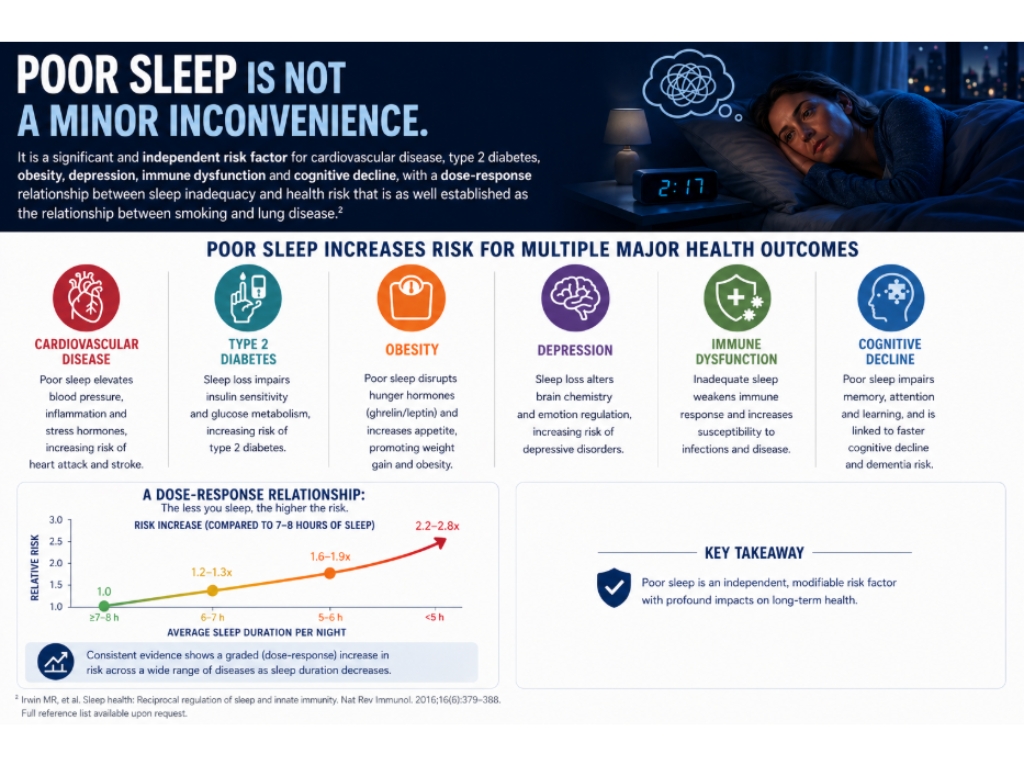
Poor sleep is not a minor inconvenience. It is a significant and independent risk factor for cardiovascular disease, type 2 diabetes, obesity, depression, immune dysfunction and cognitive decline, with a dose-response relationship between sleep inadequacy and health risk that is as well established as the relationship between smoking and lung disease.²
Understanding what sleep actually does, what disrupts it, and what can be done to restore it, is therefore not a peripheral wellness consideration. It is a central question of healthcare.
-
What Happens When You Sleep?
Sleep is not a single uniform state. It is an organised sequence of distinct stages, each with specific biological functions, that cycles through the night in a predictable pattern. Sleep is divided into two broad categories: non-rapid eye movement (NREM) sleep, and rapid eye movement (REM) sleep.
NREM sleep is itself divided into three stages of progressively deeper sleep, moving from light sleep through to slow-wave sleep, also known as deep sleep, which represents the most physically restorative phase of the sleep cycle. REM sleep, in which the brain is highly active and most vivid dreaming occurs, is the phase most critical for cognitive processing, emotional regulation and memory consolidation.³
A complete sleep cycle, moving from light NREM through deep sleep and into REM, lasts approximately ninety minutes, and a full night of healthy sleep typically involves four to six of these cycles. Critically, the proportion of deep sleep is greatest in the earlier cycles of the night, while REM sleep predominates in the later cycles.
This means that both the total duration of sleep and its timing matter. Truncating sleep at either end of the night selectively removes different stages, producing deficits that are not simply quantitative but qualitative.
Why Does Deep Sleep Matter?
Deep sleep, the slow-wave stage of NREM sleep, is the phase during which the body performs its most intensive physical repair. Growth hormone secretion, which drives tissue repair and cellular regeneration, occurs almost exclusively during deep sleep.⁴ The glymphatic system, the brain’s waste clearance mechanism, is most active during this stage, flushing metabolic byproducts, including amyloid-beta, a protein implicated in the development of Alzheimer’s disease, from brain tissue.⁵
Immune function, blood pressure regulation and glucose metabolism are all significantly influenced by the quality and quantity of deep sleep obtained each night. Deep sleep importance extends to metabolic health in ways that are frequently underappreciated. A study published in the Annals of Internal Medicine found that selective suppression of slow-wave sleep, without reducing total sleep duration, was sufficient to produce a significant reduction in insulin sensitivity, equivalent in magnitude to the metabolic effect of gaining 8 to 13 kilograms of body weight.⁶
This shows just how sleep quality and sleep architecture matter as much as sleep quantity, and that adequate hours in bed are not sufficient if the deeper, more restorative stages of sleep are being disrupted.
Why Does REM Sleep Matter?
REM sleep is the stage most associated with dreaming, but its biological significance extends well beyond the content of dreams. REM sleep is the phase during which the brain processes and consolidates emotional memories, strips the emotional charge from difficult experiences, and integrates new information with existing knowledge.⁷
It is the phase in which creative problem-solving is supported, emotional resilience is built, and the regulation of mood-relevant neurotransmitters, including serotonin and noradrenaline, is maintained. The consequences of REM sleep deprivation are substantially psychological and cognitive. Insufficient REM sleep is associated with heightened emotional reactivity, impaired ability to regulate responses to stress, reduced capacity for empathy, and a significantly elevated risk of anxiety and depression.⁸
It is also associated with impairment of the procedural and associative memory consolidation that supports learning, skill acquisition and cognitive flexibility. REM sleep benefits are central to psychological health and cognitive performance in ways that accumulate across days and weeks of disruption.
What Is The Circadian Rhythm?
Underlying the entire architecture of sleep is the circadian rhythm, the approximately twenty-four-hour biological clock that regulates the timing of sleep and wakefulness alongside a vast array of other physiological processes including hormone secretion, body temperature, immune function, digestion and cell division.⁹
The circadian rhythm is generated by the suprachiasmatic nucleus, a small region of the hypothalamus, and is synchronised primarily by light exposure, particularly the blue wavelengths present in natural daylight. A well-functioning circadian rhythm produces a predictable daily pattern of rising and falling melatonin, the hormone that signals darkness and promotes sleep onset, and cortisol, which peaks in the early morning to support waking alertness and falls through the day.
When this rhythm is aligned with the natural light-dark cycle and with consistent behavioural patterns around sleep timing, it produces reliable, well-timed sleep of good quality. When it is disrupted, the consequences extend far beyond feeling tired. Circadian misalignment, produced by shift work, frequent transmeridian travel, irregular sleep schedules or inappropriate light exposure at night, is associated with increased risk of metabolic syndrome, cardiovascular disease, certain cancers, impaired immune function and mood disorders.¹⁰
The concept of circadian rhythm reset, returning the body’s master clock to alignment with the natural environment, is central to most effective approaches to improving sleep in people whose rhythm has become dysregulated.
What Are The Root Causes of Poor Sleep?
Poor sleep in the UK is both widespread and frequently misunderstood, with many people treating it as a symptom to be suppressed rather than a signal to be investigated. Identifying the insomnia root cause, rather than simply managing the surface symptom, is the approach most likely to produce lasting improvement.
Insomnia, defined as difficulty initiating or maintaining sleep, or waking earlier than desired, associated with daytime impairment, affects approximately one in three adults in the UK at any given time and is chronic in approximately one in ten.¹¹ It has multiple potential contributors that commonly interact, and identifying which are most relevant for an individual is the starting point for effective treatment.
Psychological Factors
Psychological factors, particularly anxiety, hyperarousal and the development of conditioned negative associations with the bedroom and bedtime, are among the most common drivers of chronic insomnia.¹²
Physiological Factors
Physiological contributors then include sleep apnoea, a condition in which the upper airway repeatedly collapses during sleep causing brief arousals that fragment sleep architecture without the person necessarily being aware of waking.
Sleep apnoea affects an estimated 1.5 million adults in the UK, the majority of whom remain undiagnosed, and is a significant and underrecognised cause of poor sleep quality, daytime fatigue, cardiovascular strain and metabolic dysfunction.¹³
Restless legs syndrome, periodic limb movement disorder, hormonal disruption including thyroid dysfunction and perimenopause, chronic pain, and nutritional deficiencies including iron, magnesium and vitamin D can all contribute to sleep disruption through distinct mechanisms, each requiring a different clinical response.¹⁴
Behavioural And Environemntal Factors
Behavioural and environmental factors, including inconsistent sleep timing, excessive caffeine consumption, alcohol use, evening screen exposure and inadequate physical activity, interact with psychological and physiological contributors in ways that can entrench poor sleep patterns even after the original precipitating cause has resolved.
How Can You Adopt A Functional Medicine Approach to Sleep?
A functional medicine approach to poor sleep begins with a thorough investigation of the individual’s specific contributors rather than the application of a standard protocol. This involves detailed assessment of sleep history, chronotype, daytime functioning, psychological factors, lifestyle patterns and relevant medical history, alongside targeted investigation of physiological contributors including hormonal status, nutritional deficiencies, inflammatory markers and, where indicated, formal sleep study to assess for sleep-disordered breathing.15
The resulting plan addresses the root causes identified rather than suppressing symptoms. Cognitive behavioural therapy for insomnia, known as CBTi, is the first-line recommended treatment for chronic insomnia and has the strongest evidence base of any intervention for the condition, producing improvements that outlast those of sleep medication and without the risks of dependence or tolerance.16
Nutritional interventions addressing identified deficiencies in magnesium, iron, vitamin D or B vitamins can remove physiological barriers to sleep quality. Circadian rhythm reset strategies, including structured light exposure, consistent sleep timing and chronotherapy approaches, address misalignment that has become entrenched through shift work, irregular schedules or prolonged disruption.
Where sleep apnoea, restless legs or other physiological diagnoses are identified, targeted treatment produces improvements in sleep quality that behavioural and nutritional approaches alone cannot achieve. This approach recognises that poor sleep is rarely the product of a single cause and that lasting improvement typically requires addressing multiple contributing factors in a coordinated and personalised way.
Sleep Care at The Health Suite Leicester
If poor sleep is affecting your energy, concentration, mood or health, the most important step is understanding why it is happening rather than simply attempting to manage it. At The Health Suite Leicester, our Sleep Clinic provides personalised assessment, diagnosis and treatment for a wide range of sleep disorders, including insomnia, sleep apnoea and restless leg syndrome.
Our experienced clinicians take a thorough approach to identifying the root causes of your sleep difficulties, developing a tailored treatment plan designed to improve sleep quality, restore energy and support your health in a lasting and clinically grounded way.
Book a private GP appointment for a sleep consultation in Leicester
Book a private GP appointment for a sleep consultation to assess sleep disorders, arrange diagnostic testing where appropriate, and provide personalised treatment options, including non-invasive ventilation when indicated.

Private GP
Private GP Clinic in Leicester. Access rapid, unhurried, same-day doctor appointments, health screenings, and instant referrals with expert medical care.

Sleep Apnoea Testing and Treatment
Private sleep apnoea testing and treatment in Leicester. Home sleep studies with hand-scored results, CPAP setup and follow-up.