Is RF Skin Tightening Safe for Darker and South Asian Skin?
- Published:
- Last medically reviewed:
Radiofrequency (RF) skin tightening uses electrical current rather than light to heat the deeper layers of the skin. Because this energy is not specifically absorbed by melanin, RF does not target skin pigment in the way many lasers do, which is the basis for its lower theoretical risk of pigmentation change compared with lasers and intense pulsed light.1
A systematic review of RF and RF microneedling in Fitzpatrick skin types III to VI found a low overall risk of hyperpigmentation and scarring, although transient post-inflammatory hyperpigmentation (PIH) was reported and many of the included studies were of limited quality.2
XERF builds on this established approach with a newer generation of needle-free RF. Early clinical studies have reported improvements in skin firmness and facial definition, including research involving some darker skin types.3,4 Understanding how XERF works and what the research shows for darker and South Asian skin can help you decide whether treatment is right for you.
How Does XERF Tighten the Skin?
RF treatment passes a controlled electrical current through the skin. Tissue resists the current, and that resistance produces heat in proportion to the tissue’s impedance, warming collagen-rich layers beneath the surface.4 The heat causes existing collagen bundles to contract and prompts the skin to remodel its collagen framework.5 The aim is a firmer, better-supported face that still looks like you, with nothing injected.
Monopolar RF has been used for facial tightening since 2002, including with the Thermage system. A 2006 review of more than 600 treatments at one US clinic recorded temporary side effects in 2.7% of treatments and no permanent ones.6 More recently, a 2025 systematic review of 15 studies involving 1,230 participants found improvements in skin firmness and texture, with high patient satisfaction and generally mild, temporary side effects. Although different RF devices were included, the findings add to the evidence supporting RF as an established treatment for facial rejuvenation.1,3
XERF builds on that foundation. It delivers 6.78 MHz and 2 MHz energy in a single pulse, with three depth settings and ten intensity levels, so treatment can be matched to your anatomy rather than a fixed protocol.4,7 Integrated surface cooling protects the skin while heat is delivered beneath it, and the system monitors skin surface temperature, interrupting RF delivery if it exceeds 43°C.4
Studies have shown that the dual-frequency mode produce greater thickening and shortening of deep dermal collagen bundles than 6.78 MHz alone.5
Why Might RF Carry a Lower Pigmentation Risk Than Lasers?
Many pigment-targeting laser and intense pulsed light treatments rely on melanin absorbing their energy. In darker skin there is more melanin in the surface layer, so more energy can be absorbed where it can cause burns and PIH, the dark marks that follow skin inflammation.
RF energy is delivered by electrical current rather than being absorbed by pigment, so it does not selectively target melanin.1
This is why RF is of particular interest to people who have been advised to avoid light-based treatments. It lowers the theoretical risk of pigmentation change but does not remove it.
Can RF Still Cause Pigmentation Problems?
Any treatment that heats skin can cause burns or inflammation, and inflammation can trigger PIH. The systematic review of RF and RF microneedling in Fitzpatrick types III to VI identified 35 studies. Seven noted transient PIH, one observed mild prolonged hyperpigmentation and one reported permanent scarring. 2
Overall, pigmentation complications were uncommon in the studies reviewed, which is encouraging for people with darker skin considering RF treatment. Microneedling adds needle trauma, and microneedling is a recognised source of dyspigmentation risk in Fitzpatrick types IV to VI.8 XERF delivers energy through intact skin without needles, so that particular risk does not apply, although surface heating still does.
Melasma is a pigmentation condition characterised by darker patches of skin, commonly affecting the face. It requires particular caution, as heat is a recognised aggravating factor alongside UV exposure and hormonal changes.9 Some energy-based treatments can aggravate pigmentation in melasma-prone skin, particularly in darker skin types. However, the risk varies according to the treatment and device used.10 Anyone with melasma needs individual assessment before any heat-based treatment.
What Does the XERF Evidence Say About Darker Skin?
The main prospective study enrolled 39 adults across four US sites, all Fitzpatrick types I to IV. Participants received two treatments, four weeks apart. Clinicians rated 92% as improved or better at 90 days, and 85% of participants reported positive satisfaction scores.Mild redness and swelling resolved without treatment, and no persistent adverse events were reported.3
The study was small and had no control group, with 90 days of follow-up, so further research is needed to establish longer-term results and outcomes in Fitzpatrick types V and VI.3 A small retrospective review of 16 women with Fitzpatrick skin types II to V after a single XERF session recorded no significant change in pigmentation and only mild, transient adverse events.4 The study also reported improvements in wrinkles, skin evenness and other measures of skin quality over three months.
A further Korean study published in 2025 examined dual-frequency monopolar RF in 20 women with Fitzpatrick skin types III and IV. Independent reviewers identified post-treatment photographs correctly in 80% of cases, and no adverse events were reported over 12 weeks.1,4 Studies of other monopolar RF devices add context. In 30 volunteers with Fitzpatrick types III to V in Thailand, a single treatment was followed by no serious adverse events over six months.11
Although a different device was used, this adds to the evidence supporting RF skin tightening in darker skin types. XERF studies have now begun to include Fitzpatrick type V skin, which is encouraging, although larger studies are still needed. Skin type and previous pigmentation problems remain important considerations when deciding whether treatment is suitable.
Who Is XERF Likely to Suit?
Monopolar RF is generally studied in people with mild-to-moderate laxity, including laxity of the lower face.11 Participants in the XERF prospective study were treated for facial laxity and lower face lifting, and it was delivered without anaesthesia, with a mean pain score of 4.2 out of 10.3
For people who want to improve firmness, laxity and definition across the face, jawline and neck without injectables or surgery, it offers a distinctive option. Because XERF works by stimulating the skin’s own collagen rather than adding volume, it may particularly appeal to people looking for a gradual, natural-looking improvement.
People with more marked laxity, or whose main concern is acne scarring, may be better served by other approaches. People with melasma, a history of PIH, or skin types in which XERF has only been studied in small numbers need particular care at assessment. RF microneedling has an established role in treating acne scarring, whereas needle-free XERF is designed primarily for improving skin firmness and laxity.2,12 Microfocused ultrasound has published safety data for skin laxity in skin of colour.1 Where another option suits you better, we will say so.
So Is RF Skin Tightening Safe for Darker Skin?
For many people with darker skin, the evidence is encouraging. RF has a sound mechanistic reason for a lower pigmentation risk than many pigment-targeting light-based treatments,1 and reviews of RF in skin of colour report a low overall risk of hyperpigmentation and scarring, with transient PIH reported.2
The longer history of RF treatment, together with newer studies involving Asian patients and darker skin types, is reassuring. The early XERF studies have also reported encouraging improvements in skin firmness and quality, with generally mild and temporary side effects.3,4,11,14 A clinician reviews your skin type, any history of PIH or scarring, melasma, how your skin has reacted to heat or previous procedures, and what you want to achieve.
Together you can decide whether XERF could help achieve the firmer, more defined appearance you are looking for.
XERF at The Health Suite
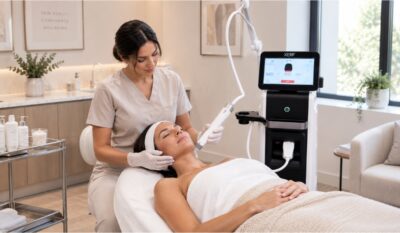
XERF is a needle-free RF treatment that heats the deeper layers of the skin to stimulate your own collagen, improving firmness, laxity and definition across the face, jawline and neck. It involves no needles and no filler, and is available at The Health Suite Leicester. Most people can return to their normal activities the same day, with little downtime.
At The Health Suite, our doctor-led consultation includes MARK-VU facial analysis and an individual assessment of your skin, pigmentation history and treatment goals. Find out whether XERF could help improve your skin firmness and facial definition.
*XERF is a trademark of Lutronic Corporation. Thermage is a trade mark of Solta Medical. The Health Suite does not offer Thermage.
XERF™ Structural Skin Tightening
XERF™ skin tightening in Leicester uses radiofrequency to improve facial firmness, laxity and jawline definition without needles or filler.