HRT and Bone Density: using a DEXA scan to inform the decision
- Published:
- Last medically reviewed:
Bone loss accelerates sharply around menopause. Oestrogen restrains the cells that break bone down, and when it falls the balance between breakdown and rebuilding shifts. The fastest losses occur in the years immediately surrounding the final period and continue at a raised rate for several years afterwards.
Most women lose a meaningful proportion of their bone density during this window. Some lose considerably more than average, and there is no symptom to indicate which group you are in.
What HRT does to bone
HRT prevents the accelerated bone loss of menopause and reduces fracture risk, including hip and vertebral fracture [1]. This is one of the better-established effects of oestrogen therapy, and it holds across the sites that matter most. The effect is present at standard doses and, for many women, at lower doses too. It applies to both oestrogen-only and combined preparations. Transdermal and oral routes both preserve bone, though they differ in other respects that form part of the wider prescribing decision.
Bone protection alone is not usually the reason to start HRT. For women considering it for menopausal symptoms, it is a substantial additional benefit that belongs in the conversation. For women with symptoms who are also losing bone quickly, it can shift the balance.
What happens when HRT stops
Bone loss resumes. The rate of loss after stopping is broadly similar to the rate seen at the menopause itself, and the density gained or preserved during treatment is gradually given back [1].
This does not make HRT pointless. Delaying loss into later life has value, and for many women the fracture risk they are protected against arrives decades later. But it does mean that stopping is a point at which bone status is worth reviewing rather than assumed, particularly for women who started early or who have other risk factors.
Where a DEXA scan fits
A bone density measurement does not determine whether HRT is right for you. It adds one piece of information to a decision that also involves symptoms, cardiovascular risk, breast cancer risk, personal history and preference.
It is most useful at three points.
- Before deciding. If your bone density is already in the osteopenia range in your early fifties, that is relevant to a decision you are weighing for other reasons. If it is entirely normal, that is also worth knowing.
- As a baseline. Whatever you decide, a measurement now makes any future measurement interpretable. Bone density is far more informative as a trend than as a single figure, and a scan taken years later with nothing to compare it against answers much less.
- When considering stopping. Knowing where your bone density sits before loss resumes informs how closely it is worth watching afterwards.
Who benefits most from measuring
- Women with an early or surgical menopause, where the exposure to low oestrogen is longer
- Women with a family history of osteoporosis or hip fracture
- Women with low body weight, or a history of restrictive eating or absent periods
- Women on long-term steroids, or with coeliac disease, inflammatory bowel disease or thyroid overactivity
- Women who have decided against HRT and want to know what their bone position is
- Women who have taken HRT for a number of years and are considering stopping
What a scan involves
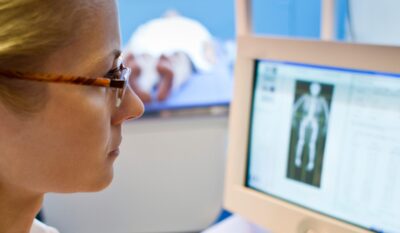
A DEXA scan of the hip and lumbar spine takes 10 to 15 minutes. You lie flat, fully clothed, and there is no injection. The radiation dose is very low, less than a chest X-ray.
The report gives a T-score, a Z-score, and where available a trabecular bone score, which assesses the internal structure of bone rather than its density [2].
Scanning at The Health Suite
We offer private DEXA scanning at our Leicester clinic including trabecular bone score, reported by a consultant radiologist. Our menopause clinic can discuss the result alongside the wider HRT decision, and no GP referral is required for either.
DEXA Bone Density Scan
Precise DEXA bone density scanning in Leicester. Measure fracture risk, T-scores, and Trabecular Bone Score (TBS) with radiologist reporting.