Osteopenia: what it means and what to do about it
- Published:
- Last medically reviewed:
Being told you have osteopenia is unsettling, largely because most people have never heard the word until it appears on a report. It sounds like a disease. It is better understood as a measurement. Osteopenia means your bone density is lower than expected for a healthy young adult, but not low enough to meet the definition of osteoporosis. It is a position on a scale rather than a diagnosis in the usual sense, and where you sit on that scale matters far less than what is happening to it over time and what else is true about you.
This article covers what the number actually means, what influences bone loss, what the evidence supports doing about it, and when medication comes into the conversation.
What the numbers mean
Bone density is measured by DEXA scanning and reported as a T-score, which compares your bone density with that of a healthy young adult.
- Normal: T-score of −1.0 or above 1
- Osteopenia: T-score between −1.0 and −2.5
- Osteoporosis: T-score of −2.5 or below
You will often also see a Z-score, which compares you with others of your own age and sex. A low Z-score is more suggestive of a specific cause of bone loss rather than the gradual decline that comes with age, and usually prompts further investigation.
The osteopenia band is wide. A T-score of −1.1 and a T-score of −2.4 are both osteopenia, and they are not remotely the same situation. This is the single most common misunderstanding about the diagnosis, and it is why a bare label tells you very little on its own.
-
Why the T-score is not the whole story
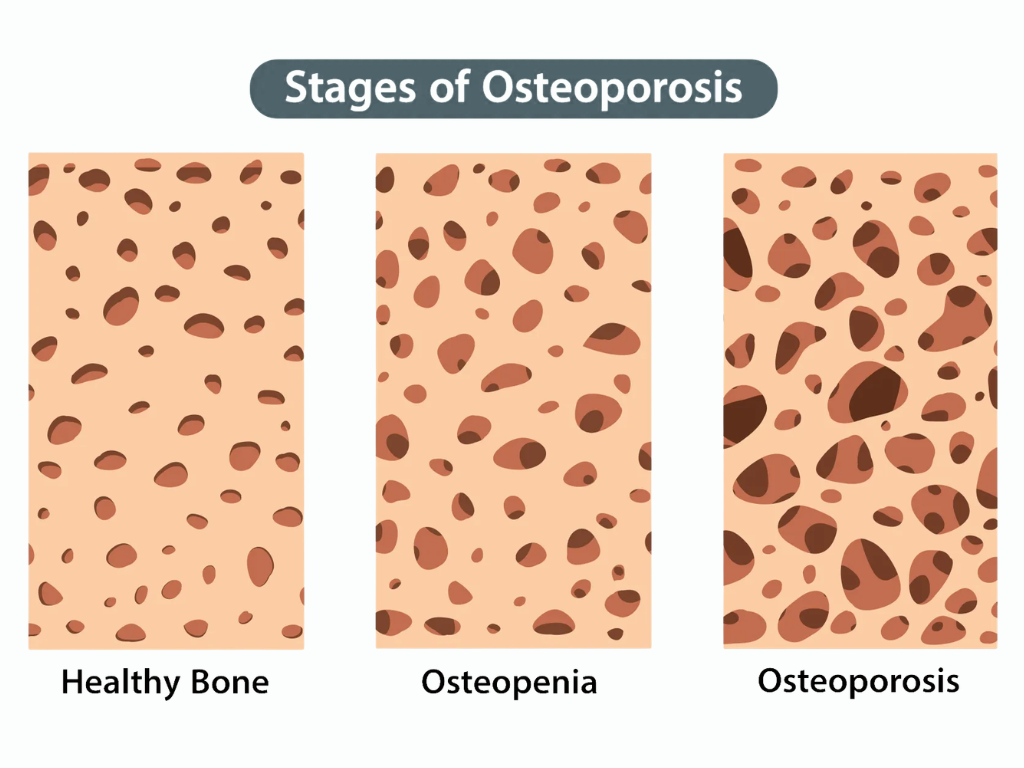
Bone density describes how much mineral is packed into a given area of bone. It says nothing about the internal architecture of that bone — the lattice of trabecular struts that gives it the ability to absorb load without breaking. Two people with an identical T-score can have quite different fracture risk depending on that structure. This is why bone density alone underestimates risk in some groups, most notably people with type 2 diabetes, whose bone density often reads as reassuring while their fracture rate is elevated3.
Trabecular bone score is a measure derived from the same DEXA image that assesses this internal texture. Where it is available, it adds meaningfully to the picture, particularly for people sitting in the middle of the osteopenia range where the decision about what to do is genuinely uncertain.
Fracture risk calculators such as FRAX go further, combining bone density with age, sex, previous fracture, parental hip fracture, smoking, alcohol, steroid use, rheumatoid arthritis and body mass index to estimate the probability of fracture over the next ten years. In practice, these tools drive clinical decisions more than the T-score does 1, 2.
What causes bone loss
Bone is living tissue that is continually broken down and rebuilt. Until roughly the age of 30 the rebuilding outpaces the breakdown and bone mass accumulates. After peak bone mass is reached, the balance gradually reverses.
The rate at which it reverses varies enormously, and is influenced by:
- Oestrogen decline. The most significant single factor in women. Bone loss accelerates sharply in the years around the menopause and continues at a faster rate for several years afterwards. Early menopause, surgical menopause and prolonged absence of periods all increase cumulative loss.
- Testosterone decline plays an analogous role in men, though usually more gradually.
- Nutritional status. Calcium and vitamin D are the obvious ones, but protein intake, vitamin K, magnesium and overall energy availability all contribute. Chronically low protein intake in older adults is under-recognised as a driver of both bone and muscle loss.
- Absorption. Coeliac disease, inflammatory bowel disease, previous bariatric surgery and long-term proton pump inhibitor use can all reduce the availability of the nutrients bone requires, sometimes silently for years.
- Physical loading. Bone responds to mechanical stress. Sedentary living, prolonged bed rest and non-weight-bearing exercise alone provide little stimulus to maintain density.
- Medications. Oral corticosteroids are the most important. Aromatase inhibitors, androgen deprivation therapy, some anticonvulsants and long-term heparin also contribute.
- Other conditions. Thyroid overactivity, hyperparathyroidism, chronic kidney disease, rheumatoid arthritis and chronic inflammatory states.
- Lifestyle factors. Smoking, high alcohol intake and low body weight are all independently associated with lower bone density.
Where osteopenia appears at a younger age than expected, or the Z-score is low, looking for one of these underlying contributors matters more than treating the number.
What the evidence supports doing
Most people with osteopenia do not need medication. What they need is to slow the rate of loss and to reduce the risk of falling. Both are more achievable than people assume.
Resistance and impact loading
This is the intervention with the strongest evidence and the one most often skipped. Bone responds to load, and walking on its own provides relatively little stimulus once the body has adapted to it.
Progressive resistance training two to three times a week, working the hips and spine in particular, has been shown to maintain or modestly improve bone density in post-menopausal women 1. Impact activity — stair climbing, hopping, jumping where joints allow — adds a further stimulus. Balance work reduces falls, which is arguably the more immediate protection against fracture.
Anyone starting from a low base, or with existing vertebral fracture, should get individual advice before beginning impact work.
Protein
Adequate protein is required for the collagen matrix that mineral is deposited onto. Requirements rise rather than fall with age, and intake commonly falls at the same time. Spreading intake across meals rather than concentrating it in the evening improves the response.
Calcium and vitamin D
Calcium is best obtained from food where possible. Vitamin D is difficult to obtain from diet or from UK sunlight for much of the year, and deficiency is common; supplementation is widely recommended, and testing before and after gives a far better guide than guessing at a dose.
Vitamin K and magnesium both have supporting roles in bone metabolism, though the evidence for supplementing them in isolation is considerably weaker than the evidence for adequacy of the basics.
The reversible contributors
Stopping smoking, moderating alcohol, addressing low body weight, correcting an untreated thyroid problem, reviewing whether a long-term proton pump inhibitor is still needed. None of these are glamorous and all of them matter.
Hormone replacement therapy
HRT prevents bone loss and reduces fracture risk in post-menopausal women, and for women who are considering it for menopausal symptoms anyway, the bone effect is a meaningful additional benefit 1. It is a decision that involves the whole clinical picture rather than the bone density alone, and it is worth having the DEXA result available when making it.
When medication is considered
Bone-specific medication is not usually recommended for osteopenia on the basis of the T-score alone. It becomes part of the conversation when the calculated fracture risk is high enough to justify it — for example where FRAX indicates a ten-year risk above the intervention threshold, where there has already been a fragility fracture, or where there is ongoing high-dose steroid treatment 1, 2.
The medicines used include bisphosphonates, denosumab and, in higher-risk cases, anabolic agents. Each has a different administration route, monitoring requirement and side-effect profile, and the decision belongs with a clinician who has seen your full history and results. The important point is that osteopenia does not automatically mean treatment, and it does not automatically mean no treatment either. It means the question is now worth asking properly.
Can osteopenia be reversed?
Partly, and the honest answer depends on what you mean. Substantial gains in bone density in adults are uncommon. What is realistically achievable for most people is slowing or halting further loss, with modest improvement in some. That is a worthwhile outcome, because fracture risk is driven by the trajectory as much as the absolute number.
The other half of the equation is falls. Improving strength and balance reduces fracture risk regardless of what happens to the density figure, and it does so relatively quickly.
How often should bone density be rechecked?
Typically every two to three years, though the interval depends on where in the osteopenia range you sit, whether you have identified risk factors, and whether anything has changed.
Repeat scans are only meaningful if they are comparable, which in practice means scanning on the same machine wherever possible. Differences between scanners are large enough to obscure real change.
Getting assessed
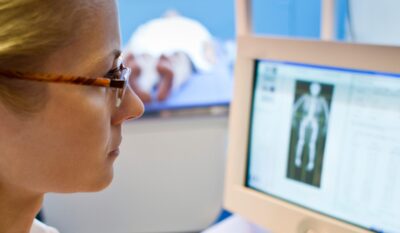
If you have been told you have osteopenia, or you have risk factors and have never been scanned, a DEXA scan gives you the measurement, and a clinical review puts it in context.
At The Health Suite in Leicester, we offer private DEXA scanning, including trabecular bone score, reported by a consultant radiologist, with no GP referral required. Where specialist input is appropriate, our rheumatology service is available at the same clinic.
DEXA Bone Density Scan
Precise DEXA bone density scanning in Leicester. Measure fracture risk, T-scores, and Trabecular Bone Score (TBS) with radiologist reporting.