Private bone density scanning: who should be screened, and why some people fall through the gap
- Published:
- Last medically reviewed:
Who should have a bone density scan?
Bone loss is silent. There is no symptom, no warning sign, and no way to feel it happening. For most people the first indication is a fracture, and by that stage a considerable amount of bone strength has already been lost.
That makes bone density one of the few things worth measuring before there is any reason to think something is wrong. The question is who benefits from measuring it, and when.
How NHS assessment works
NHS scanning is targeted rather than universal, and the reasoning is sound: scanning everyone would find a great deal of osteopenia that never progresses to fracture. Assessment usually begins with a fracture risk calculation such as FRAX or QFracture, which combines age, sex, previous fracture history, parental hip fracture, smoking, alcohol, steroid use, rheumatoid arthritis and body mass index. Where the calculated risk crosses a threshold, a DEXA scan follows.
Current NICE guidance (NG259, July 2026) directs assessment towards, among others1:
- Anyone aged 50 and over who has had a fragility fracture — a break from a fall at standing height or less
- Anyone aged 50 and over on current or frequent systemic glucocorticoids
- Consideration of assessment in all men aged 75 and over and all women aged 65 and over
- Adults aged 50 to 74, and post-menopausal women under 65, with risk factors such as low body weight, a parental hip fracture, smoking or high alcohol intake
If you fall into one of these groups, speak to your GP. There is no reason to pay privately for something you can access on the NHS.
Who falls outside the criteria
The threshold approach works well at a population level. It leaves out some people who have a genuine reason to want the information.
- Women in the years around the menopause. Bone loss accelerates sharply at this point and continues at a raised rate for several years afterwards. A woman of 51 with no fracture history will usually not meet the criteria, yet this is precisely the window in which loss is fastest and in which knowing the starting point is most useful.
- Anyone deciding about HRT. Bone protection is one of the established benefits of HRT. Having the bone density measurement available makes that decision better informed, in either direction.
- People with a strong family history who do not have the specific parental hip fracture that risk calculators ask about.
- People losing weight rapidly, including on GLP-1 medication. Rapid weight loss is associated with loss of bone and muscle alongside fat, and there is currently no routine monitoring of this.
- Those with conditions affecting absorption — coeliac disease, inflammatory bowel disease, previous bariatric surgery, long-term proton pump inhibitor use — where the effect on bone can build quietly over years.
- Athletes and very active people with low body weight, or anyone with a history of restrictive eating or prolonged absence of periods.
- Men under 75 with risk factors. Osteoporosis in men is consistently under-investigated, and the outcomes after hip fracture are worse than in women.2
What the scan tells you, and what it does not
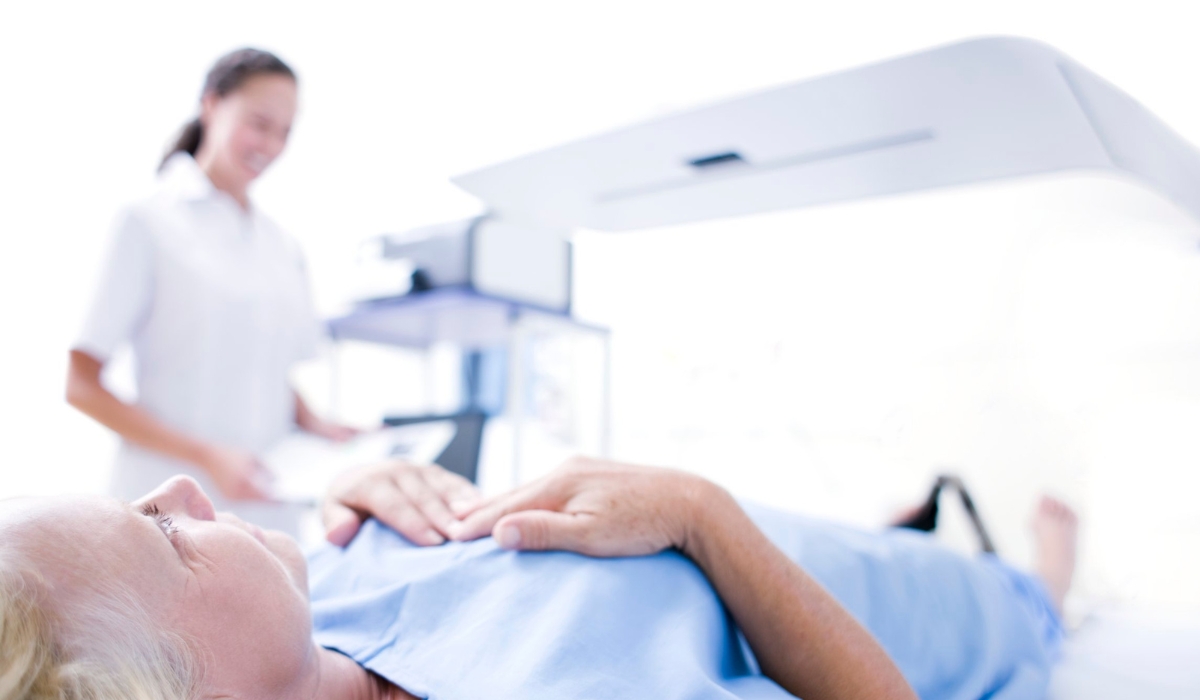
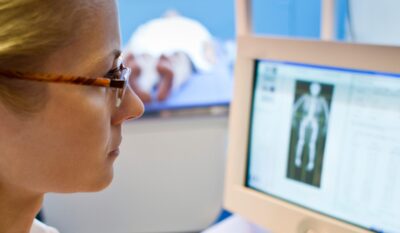
A DEXA scan of the hip and lumbar spine gives a T-score and a Z-score. It is quick, painless and uses a very low radiation dose — less than a chest X-ray.
What it does not tell you on its own is your fracture risk. Density is one input. Bone quality, falls risk, medication and medical history all contribute, which is why a number without a clinical interpretation has limited value.
Trabecular bone score, derived from the same image, assesses the internal structure of bone rather than its density, and identifies some people whose risk is higher than their T-score suggests 3. It is not routinely available at most private scanning services.
Is private screening worth it?
It is worth it if the result would change something — a decision about HRT, whether to take bone health seriously in your training and nutrition, whether to investigate an absorption problem, or simply having a baseline to compare against in three years. It is worth less if you already meet NHS criteria, in which case the NHS route is the sensible first step, or if you would not act on the result either way.
Scanning at The Health Suite
We offer private DEXA scanning at our Leicester clinic, including trabecular bone score, reported by a consultant radiologist and reviewed by a THS doctor before it reaches you. No GP referral is required, and where specialist assessment is appropriate our rheumatology service is available at the same clinic.
DEXA Bone Density Scan
Precise DEXA bone density scanning in Leicester. Measure fracture risk, T-scores, and Trabecular Bone Score (TBS) with radiologist reporting.