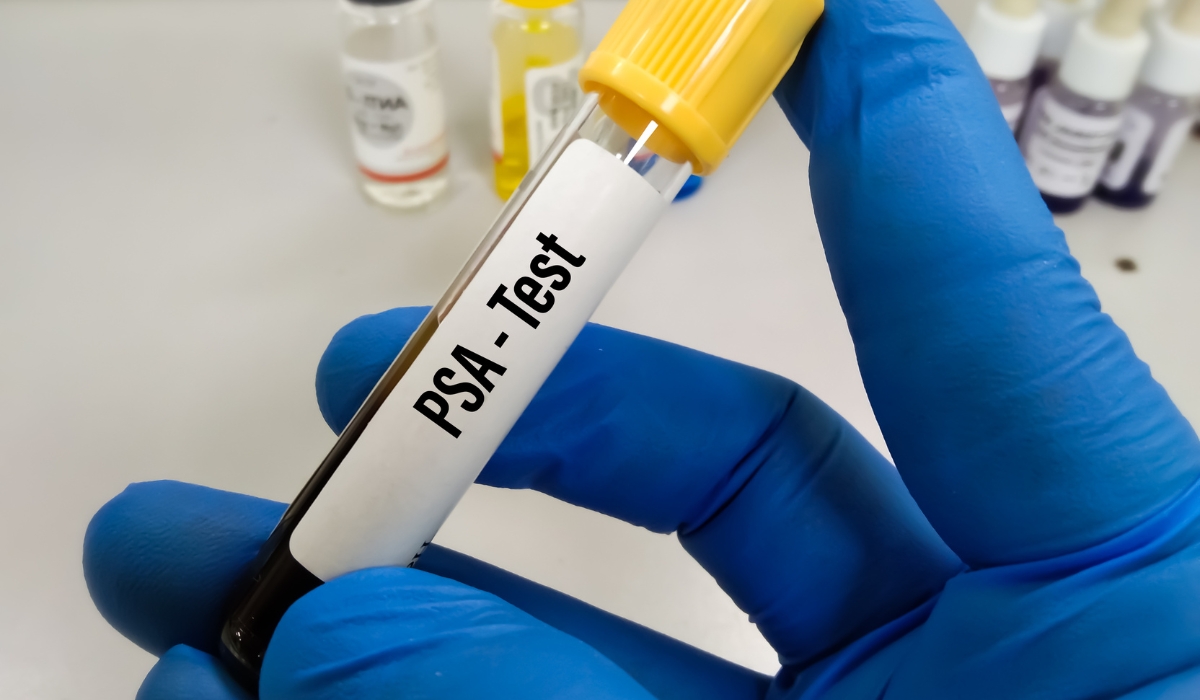
PSA Test Explained: Should You Have One and What Do the Numbers Mean?
- Published:
- Last medically reviewed:
Prostate cancer is now the most commonly diagnosed cancer in England, with more than 56,000 men diagnosed each year and incidence rates that have risen by 25% between 2019 and 2023.1
Data show that more than 10,000 men die from it every year in England alone, equating to approximately one per hour.1
When prostate cancer is found early, it can often be treated successfully. Once it has spread to other parts of the body, treatment is usually aimed at controlling it rather than curing it. [Localised prostate cancer] [Advanced prostate cancer]
The prostate-specific antigen (PSA) test is the most widely used tool for early detection, and it is also one of the most discussed and debated tests in medicine.
Understanding what the test actually measures, what the numbers mean in the context of age, and what happens when a result comes back raised is the starting point for making an informed choice.
What Does The PSA Test Measure?
PSA is a protein produced by cells in the prostate gland, both normal prostate cells and prostate cancer cells.2 A small amount is always present in the bloodstream, and the test measures its concentration in nanograms per millilitre of blood.
PSA is produced by the prostate rather than exclusively by cancer, which means that the test is prostate-specific rather than cancer-specific.3
Because the prostate naturally grows larger as a man ages, PSA levels often rise with age even when cancer is not present.
A PSA level that would warrant investigation in a man in his early fifties may be entirely within the expected range for a man in his seventies, which is why age-specific reference ranges are used in clinical practice rather than a single universal threshold.4
What Do The Numbers Mean?
The widely used age-specific, healthy reference ranges for PSA applied in UK practice are:4
- Under 3.5 ng/ml for men aged 50 to 59
- Under 4.5 ng/ml for men aged 60 to 69
- Under 6.5 ng/ml for men aged 70 to 79
NICE guidelines recommend a referral threshold of more than 3.5 ng/ml for symptomatic men aged 50 to 59, and the Prostate Cancer Risk Management Programme notes that most men have a PSA level below 3.0 ng/ml, with clinical judgement applied to results above this in asymptomatic men. For someone without symptoms, a PSA result should be interpreted in the context of their age, ethnicity, family history, previous PSA results, medication and any recent infection or prostate procedure.4,5
A result above the age-specific threshold does not mean cancer is present. It means the probability of a significant underlying prostate condition is sufficient to warrant further investigation. Approximately two-thirds of men with a raised PSA result will not have prostate cancer when investigated further.3
The conditions most commonly responsible for a raised PSA in the absence of cancer are benign prostatic hyperplasia, in which the prostate enlarges without malignancy, and prostatitis, which is inflammation of the prostate, often triggered by infection.6 Ejaculation, cycling and vigorous exercise can also produce temporary elevations in PSA levels, which is why certain activities are typically avoided in the 48 hours before the test. A urinary tract infection can also affect the result; PSA testing is generally delayed for four to six weeks after the infection has cleared. 2,5
Equally, a normal PSA result does not rule out prostate cancer. Approximately one in seven men with prostate cancer do not have an elevated PSA level, meaning the test can produce false negatives as well as false positives.3
Why Do PSA Trends Matter?
A single PSA reading is informative, but it is still only a snapshot. The way the number changes over time, referred to as PSA velocity, is often more clinically significant than any individual result.7 A PSA that rises steadily and rapidly over a series of tests, even if it remains within the age-specific reference range, may warrant clinical investigation more urgently than a higher but stable reading.
Conversely, a result that sits just above the threshold but has remained there unchanged for several years may carry different implications than a number that has doubled in twelve months. This is one of the key reasons why one-off PSA testing provides a more limited clinical picture than regular, timed retesting. Serial measurements allow clinicians to assess velocity and trend rather than relying on a single static figure, and this approach supports more accurate risk detection. The timing of re-testing should be discussed with their clinician.
However, PSA velocity should not be considered in isolation or treated as more important than the wider clinical picture. Age, symptoms, ethnicity, family history, prostate size, medication, examination findings and, where appropriate, MRI results can all influence what should happen next.
Who Should Consider a PSA Test?
In England, men and anyone with a prostate can ask their GP about PSA testing. For people without symptoms who are aged 50 or over, the decision should follow a balanced discussion about the potential benefits and limitations of the test.8 Though it has been the subject of much discussion, the test is not part of a national screening programme, and the decision to have one is made on an individual basis, depending on a person’s risk factors and how they feel about the possible consequences of a raised result.
Certain groups have a significantly higher baseline risk of prostate cancer and may benefit from testing from an earlier age. Black men in the UK are approximately twice as likely to be diagnosed with prostate cancer as white men, and tend to be diagnosed at a younger age on average.9
Men with a first-degree relative who had prostate cancer are also at meaningfully elevated risk.9 Prostate Cancer UK recommends that men in these higher-risk groups consider discussing PSA testing with their GP from the age of 45. The UK National Screening Committee has, however, recommended a nationally managed programme of PSA testing every two years for men aged 45 to 61 who have a pathogenic BRCA2 variant and a relevant family history of breast, ovarian, pancreatic or prostate cancer.
Are There Particular Symptoms To Watch Out For?
Men of any age should seek clinical assessment promptly if they are experiencing symptoms that might indicate a prostate problem.
This includes:
- Difficulty urinating
- A weak or interrupted urine flow
- Increased urinary frequency, particularly at night
- Blood in the urine or semen
In this setting, a PSA test is part of a symptomatic assessment rather than a screening decision.
What Happens After a Raised Result?
The standard pathway following a raised result may begin with a repeat PSA test to confirm the finding and exclude transient causes of elevation. A very high PSA, an abnormal prostate examination or other concerning features may instead lead to referral without waiting for a repeat test.
If specialist assessment is required, current NICE guidance recommends a multiparametric magnetic resonance imaging scan of the prostate before any biopsy is considered.10
Magnetic resonance imaging can identify whether a suspicious area is present, guide any subsequent biopsy toward areas of concern, and avoid unnecessary biopsy in men whose imaging and wider clinical assessment are reassuring. The move to magnetic resonance imaging as the first-line investigation after a raised PSA has substantially reduced the number of unnecessary biopsies performed under the previous approach.
If imaging identifies a suspicious lesion, a targeted biopsy is performed to obtain tissue for histological analysis. The result of the biopsy determines whether cancer is present and, if so, its grade and risk category, which together inform decisions about whether active treatment or active surveillance is appropriate.
How Can Private Testing Add Value?
PSA testing is available through NHS primary care, but waiting times for any further assessment can vary between areas. For men who want a faster route from result to clinical action, private testing offers direct access to both the initial PSA test and, where the result warrants it, onward specialist review without NHS waits.
A private PSA test also ensures the result is interpreted by a clinician who can contextualise it within your age, medical history, symptoms and prior test results, rather than being communicated as a number without clinical discussion. For men with a borderline or raised result who want to understand promptly what it means and what the appropriate next step is, that clinical interpretation is the most important part of the process.
PSA Testing at The Health Suite
Prostate cancer can often be treated successfully when found early, but PSA testing has both benefits and limitations. The decision to test should be informed by your age, symptoms, risk factors and personal preferences. At The Health Suite, private PSA testing is available with rapid results and clinician interpretation included.
Where a result warrants further investigation, our urology pathway provides specialist assessment and onward management without the delays of the NHS referral route.

Prostate Cancer Blood Test & GP Appointments
Experiencing changing urinary habits or over 50? Schedule an accurate prostate blood test and examination in Leicester.