What an Ambulatory ECG Can Pick Up That a One-Off ECG Doesn’t
- Published:
- Last medically reviewed:
A standard electrocardiogram (ECG) is one of the most widely used tests in clinical medicine. It is quick, non-invasive and highly informative when the rhythm disturbance being investigated is present at the moment the recording is taken.
For many people with palpitations, dizziness, unexplained breathlessness or episodes of near-blackout, however, it is not present. The symptoms come and go. The standard ECG catches a quiet moment and returns a normal result. The investigation feels complete, but the question has not actually been answered.
Ambulatory ECG exists precisely to close that gap. By recording the heart’s electrical activity continuously over an extended period, it captures what a brief resting recording cannot: the rhythm as it behaves in the real world, across time, during normal activity, sleep and the specific circumstances that tend to bring on symptoms.
What Is an Ambulatory ECG?
An ambulatory ECG is a portable form of ECG monitoring used to record the heart’s electrical activity continuously over a defined monitoring period.
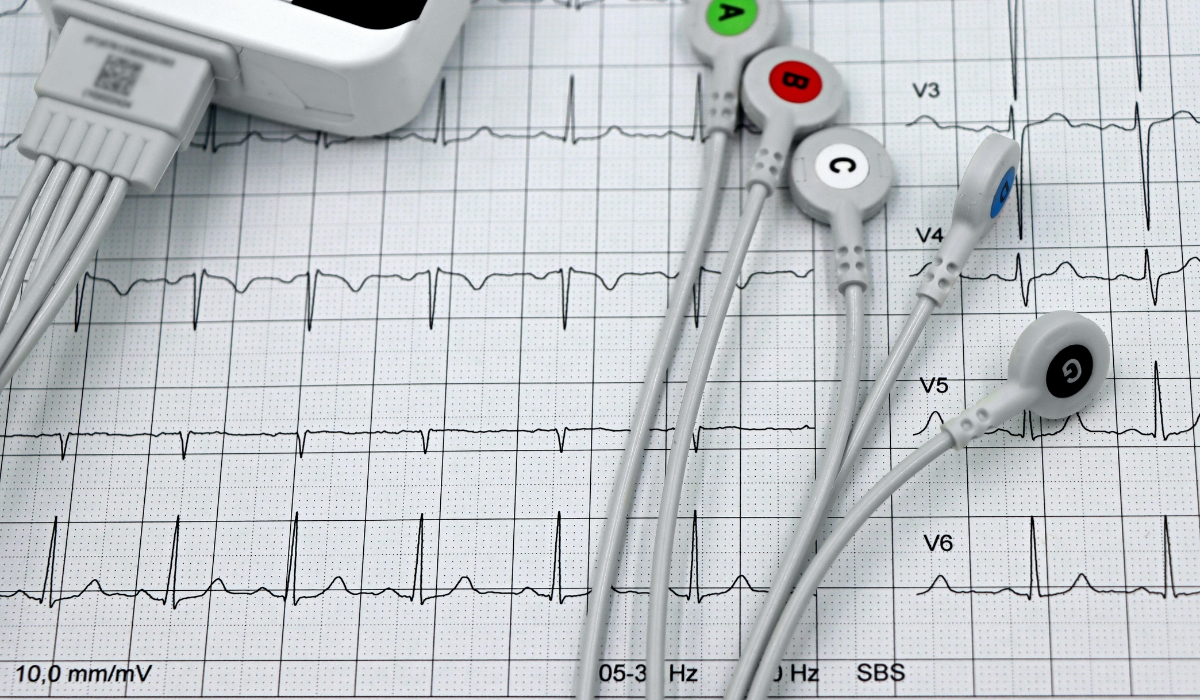
Adhesive electrodes are placed on the chest and connected to a lightweight recorder that can be worn under clothing during normal daily activities.1 The recording runs uninterrupted throughout the monitoring period, capturing every heartbeat across the full duration of the test.
Monitoring periods range from 24 hours to several days or longer, depending on the clinical indication and how frequently symptoms are occurring. At The Health Suite, monitoring is available from 24 hours up to 7 days. Shorter durations are appropriate when symptoms are more frequent. Longer periods substantially increase the probability of capturing an intermittent event that would otherwise be missed. Alongside the device, the patient keeps a symptom diary, logging the time and nature of any symptoms they experience so that the recorded rhythm at those exact moments can be identified and assessed.2
The resulting recording is then analysed by a clinician, who reviews the full rhythm record, identifies any abnormalities and correlates them with the symptom log. This combination of continuous data and symptom correlation is what makes the ambulatory ECG diagnostically meaningful in a way that a ten-second resting recording cannot be.
What Can an Ambulatory ECG Detect?
The range of findings that ambulatory ECG monitoring can identify is broad, and many of them are clinically significant in ways that directly determine treatment. Atrial fibrillation is one of the most important, given that paroxysmal episodes may resolve spontaneously and leave no trace on a resting recording.
A study comparing 24-hour Holter monitoring with 7-day monitoring in patients with cryptogenic stroke who had a normal initial 24-hour recording found that 7-day monitoring identified atrial fibrillation in 10% of patients and supraventricular arrhythmias in 37.5%, findings that were entirely absent from the shorter recording.3
Because atrial fibrillation carries a substantially elevated stroke risk, confirming the diagnosis can directly alter management, including decisions about anticoagulation based on an individual’s stroke and bleeding risk. Beyond atrial fibrillation, ambulatory monitoring can detect supraventricular tachycardia, episodes of abnormally rapid heart rhythm originating above the ventricles, ventricular tachycardia, pauses and conduction abnormalities including atrioventricular block, and significant bradycardia, an abnormally slow heart rate that may cause dizziness or blackouts.4
Incidental findings identified in screening studies have included high-grade atrioventricular block detected in patients who had no prior suspicion of conduction disease, a finding requiring prompt clinical assessment.5
This range of detection is captured in an International Society for Holter and Noninvasive Electrocardiology and Heart Rhythm Society consensus statement, which confirms that ambulatory ECG is the appropriate tool for evaluating symptoms including:
- Palpitations
- Syncope
- Dizziness
- Chest pain and unexplained breathlessness where an intermittent arrhythmic cause is possible.2
The same statement also highlights the importance of ambulatory ECG in establishing whether symptoms are occurring at the same time as a rhythm disturbance.2
Why Does The Duration of Monitoring Matter?
The diagnostic yield of ambulatory ECG monitoring generally increases with longer monitoring when the suspected rhythm disturbance is intermittent, and this relationship is relevant to choosing the right monitoring duration for each patient. A study comparing 14-day ECG patch monitoring with standard 24-hour Holter monitoring found detection rates of 66% for paroxysmal arrhythmias, including atrial fibrillation, at 14 days, compared with 9% for 24-hour monitoring alone.6
A cross-sectional study of 140 patients referred for Holter monitoring found that while 24-hour recording identified clinically significant arrhythmias in approximately one in five patients, a normal result in high-risk individuals, particularly those with syncope, warranted extended monitoring because the negative result could not exclude an intermittent cause with sufficient confidence. Clinical guidance recommends selecting the type and duration of ambulatory monitoring according to how frequently symptoms or suspected arrhythmic episodes occur.7
The clinical decision about monitoring duration is therefore guided by symptom frequency and clinical context. If symptoms are occurring daily or several times per week, 24-hour monitoring may be sufficient to capture them. If symptoms occur less predictably or at longer intervals, a 7-day recording substantially increases the probability of an event being recorded and correlated with a documented symptom.
What Can a Normal Result Tell You?
A normal ambulatory ECG result is itself clinically meaningful, but only when symptoms have occurred during the recording period and no corresponding rhythm abnormality has been detected. If a patient experiences their typical palpitations during the monitoring period and the rhythm at that exact moment is entirely normal, that is useful and reassuring information: it makes a rhythm disturbance much less likely to be the cause of those symptoms at that time, and investigation can appropriately turn to other causes.
A normal ambulatory ECG result in which no symptoms occurred during the recording period, however, does not exclude an arrhythmia. It may mean the test period did not coincide with a symptomatic episode. In this situation, extended monitoring or a repeat test covering a longer period is the appropriate clinical step.2
Who Should Consider Ambulatory ECG Monitoring?
Ambulatory ECG monitoring may be appropriate for any individual experiencing unexplained palpitations, episodes of dizziness or pre-syncope, blackout or near-blackout without a clear non-cardiac cause, unexplained breathlessness, or a sensation of irregular or racing heartbeat where the resting ECG has been normal or inconclusive.8
Longer-term rhythm monitoring may also form part of specialist assessment following an ischaemic stroke or TIA of undetermined cause where paroxysmal atrial fibrillation is suspected. Ambulatory ECG can also be used in selected patients with known heart disease, or to assess treatment, where there is a specific clinical indication.
A wearable consumer device that flags an irregular rhythm can prompt useful clinical suspicion. However, an irregular-rhythm alert alone is not a diagnosis, and wearable findings should be reviewed by an appropriately qualified clinician. The ambulatory ECG remains the clinically appropriate tool when continuous monitoring and correlation of the heart rhythm with symptoms are required.
Ambulatory ECG at The Health Suite
At The Health Suite, our 24-hour ECG test is a continuous, non-invasive recording of your heart’s rate and rhythm over 24 hours.
You wear a small portable device on your belt or waistband, with electrodes attached to your chest, and carry on with your normal daily activities, including sleep, throughout the monitoring period. Results are typically available within 24 working hours, and our clinicians use the recording to identify symptoms that may not have appeared on a standard resting ECG.
Where a 24-hour recording period is insufficient to capture infrequent symptoms, extended monitoring up to 7 days is available.
24-hour to 7-day monitoring can capture rhythm disturbances a single ECG misses. Book an ambulatory ECG at The Health Suite:
ECG (Electrocardiogram)
Private adult resting ECG testing in Leicester. Fast, painless heart rhythm checks with an expert clinical report ready within 24 working hours.

24 Hour ECG Test
Private 24-hour ambulatory ECG testing in Leicester. Monitor your heart rhythm naturally during daily activities with rapid, expert analysis

Paediatric ECG (Electrocardiogram)
Gentle, child-friendly resting heart checks for palpitations, chest pain, and pre-medication ADHD screens.